DynamicBuffer
From v9.4
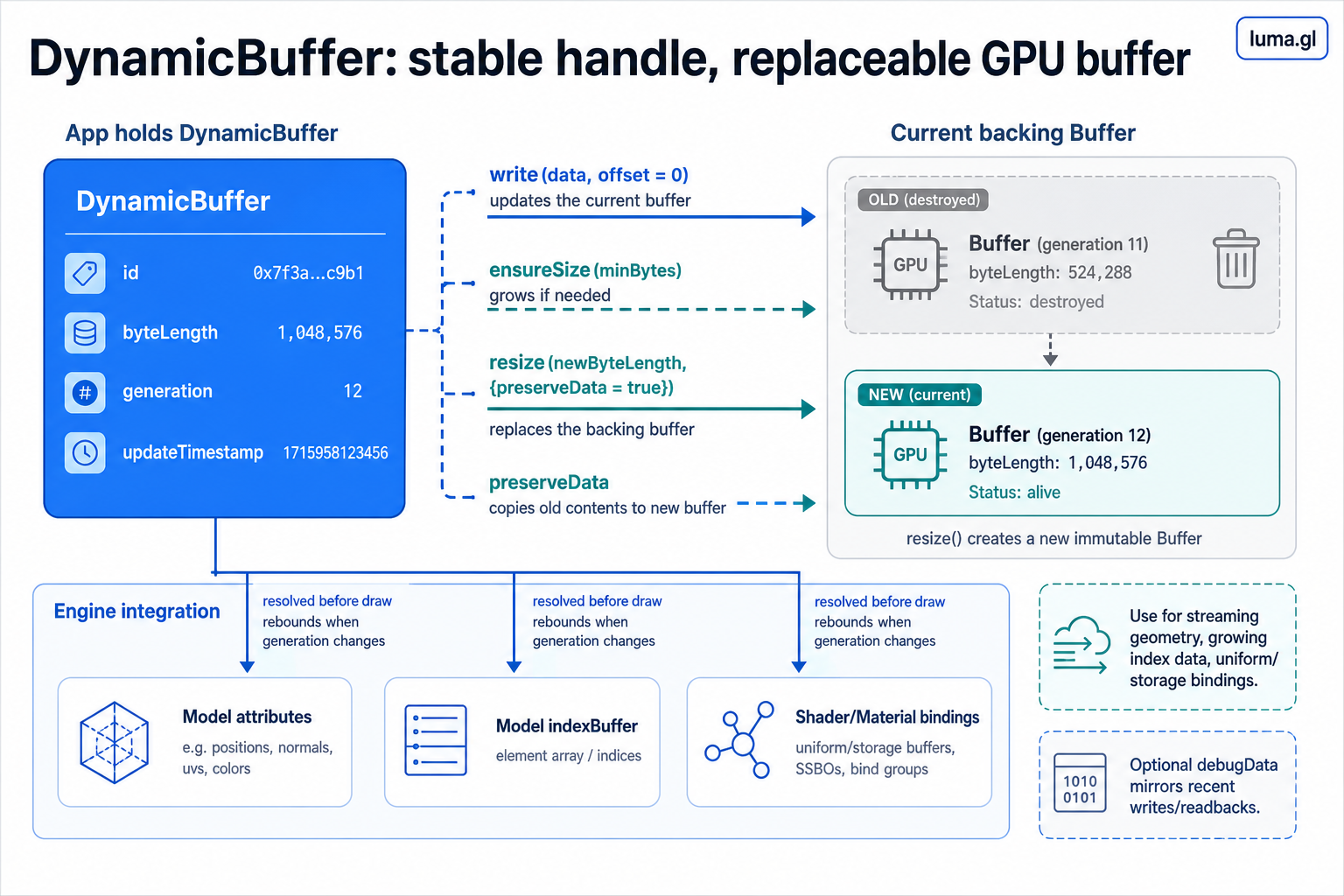
DynamicBuffer is the engine-level wrapper for applications that need a stable buffer object whose underlying GPU Buffer can grow or be replaced.
It is useful for streaming geometry, dynamic index data, uniform data, and any workflow where the required byte length is not known up front.
Model and Material accept DynamicBuffer bindings directly and resolve them to the current backing buffer during draw preparation.
Usage
import {Buffer} from '@luma.gl/core';
import {DynamicBuffer, Model} from '@luma.gl/engine';

const positions = new DynamicBuffer(device, {
  data: new Float32Array([0, 0, 0, 1, 0, 0, 0, 1, 0]),
  usage: Buffer.VERTEX | Buffer.COPY_DST | Buffer.COPY_SRC
});

const model = new Model(device, {
  vs,
  fs,
  attributes: {positions},
  bufferLayout: [{name: 'positions', format: 'float32x3'}]
});

positions.ensureSize(1024, {preserveData: true});
positions.write(new Float32Array([0, 0, 0]), 0);
Types
DynamicBufferProps
export type DynamicBufferProps = Omit<BufferProps, 'handle' | 'onMapped'> & {
  debugData?: boolean | {maxByteLength?: number};
};
DynamicBufferProps mirrors normal BufferProps except that it owns buffer creation and does not accept an external handle or mapped callback.
DynamicBufferRange
export type DynamicBufferRange = {
  buffer: Buffer | DynamicBuffer;
  offset?: number;
  size?: number;
};
Use a range when a shader binding should point at only part of the current backing buffer.
Properties
device, id
Owning device and application-provided identifier.
buffer: Buffer
Current immutable core buffer. This object changes after a successful resize().
byteLength: number
Current backing buffer byte length.
ready: Promise<Buffer>, isReady: boolean
Compatibility properties for engine code that handles dynamic resources. DynamicBuffer is ready synchronously after construction.
generation: number
Increments whenever resize() replaces the backing buffer. Engine binding caches use this value to detect when they must rebind.
updateTimestamp: number
Tracks writes, resize operations, and debug-data-producing readbacks.
debugData: ArrayBuffer
Optional CPU-side mirror of recent writes and readbacks. Enable it with debugData: true or debugData: {maxByteLength}.
destroyed: boolean
Indicates whether the dynamic buffer has been destroyed.
Methods
constructor(device: Device, props: DynamicBufferProps)
Creates the initial backing buffer.
write(data, byteOffset = 0): void
Writes data into the current backing buffer.
mapAndWriteAsync(callback, byteOffset?, byteLength?): Promise<void>
Maps a range for writing through the backing buffer API.
readAsync(byteOffset?, byteLength?): Promise<Uint8Array>
Reads bytes from the backing buffer.
mapAndReadAsync(callback, byteOffset?, byteLength?): Promise<T>
Maps a range for reading through the backing buffer API.
resize(options): boolean
Replaces the backing buffer with options.byteLength.
Pass preserveData: true to copy bytes from the previous buffer into the new buffer.
Returns false when the byte length is unchanged.
ensureSize(byteLength, options?): boolean
Grows the backing buffer only when byteLength is larger than the current size.
getBinding(range?): Binding
Returns the current backing buffer, or a core buffer range binding when offset or size is supplied.
destroy(): void
Destroys the current backing buffer and clears debug data.
Remarks
DynamicBufferis directly supported byModelattributes, index buffers, and bindings.DynamicBufferis directly supported by material-owned bindings created withMaterialFactory.- Resizing replaces the underlying
Buffer; keep theDynamicBufferobject as the long-lived application handle. - Data preservation during resize requires copy support and is not available on
NullDevice.