GPU Primitives and Command Graphs



Overview
This guide proposes a direction for luma.gl 10 and documents the first working proof of that direction. The central idea is simple: luma.gl can have more lasting impact by exposing reusable GPU building blocks than by accumulating isolated visual effects. A bloom implementation, a particular material, or one culling demo may be useful, but the mechanisms underneath those features—parallel scans, compaction, indirect commands, explicit resource scheduling, and GPU-resident tables—can support entire families of applications.
Scientific visualization, trace viewers, geospatial rendering, large scatterplots, text layout, particle systems, and deck.gl layers repeatedly solve variations of the same problems. They decide which records are active, transform or expand those records, group or sort them, create draw arguments, render the result, and occasionally read a small answer back. The GPU is excellent at that work, but applications often assemble it from unrelated helpers that allocate hidden scratch buffers, submit commands eagerly, or return results only after a CPU synchronization point.
The experimental GPU primitives replace that pattern with an explicit dataflow:
GPU-resident source data
        ↓
visibility or application predicate
        ↓
exclusive scan
        ↓
stable compaction
        ↓
indirect draw arguments
        ↓
pre-recorded render commands
Concepts
A primitive is a narrow reusable GPU operation with explicit input, output, ownership, and
encoding contracts. An algorithm may compose several compute passes to provide one data
semantic such as scan, compaction, reduction, or sorting. A workflow combines primitives around
an application-level outcome such as visibility or picking. GPUCommandGraph schedules all of
them by declared resource uses without owning submission or the application's frame loop.
Consecutive compute nodes share a physical compute pass by default, while resource dependencies, copy/render boundaries, debug labels, and individual node statistics remain explicit. Timestamp profiling automatically restores separate passes when per-node GPU timings are required. The graph also aliases compatible transient buffers and textures with disjoint lifetimes, so improvements to generic sorting or hierarchy construction benefit every graph-based workflow.
These layers deliberately preserve GPU-resident identity and dataflow. Source rows keep stable IDs, variable-size results publish a count alongside fixed-capacity storage, and indirect commands let a later render pass consume that count without a CPU synchronization point.
The implementation consists of GPUCommandGraph, GPUTextureHistory, typed graph data views,
GPUScan, GPUCompaction, GPUMask, GPUVisibilityWorkflow, GPUVirtualGeometrySelection,
GPUHierarchyLayout, GPUGraphTraversal, GPUAncestorProjection, GPUSort, GPUBatchSort,
GPUSegmentedSort, GPUBVH, GPUSegmentedBVH, GPUReduction, GPUHistogram, GPUGridBinning,
GPUGridAggregation, GPUGroupAggregation, GPUFFT2D, GPUIndexPickingTarget, GPUReadbackRing, and
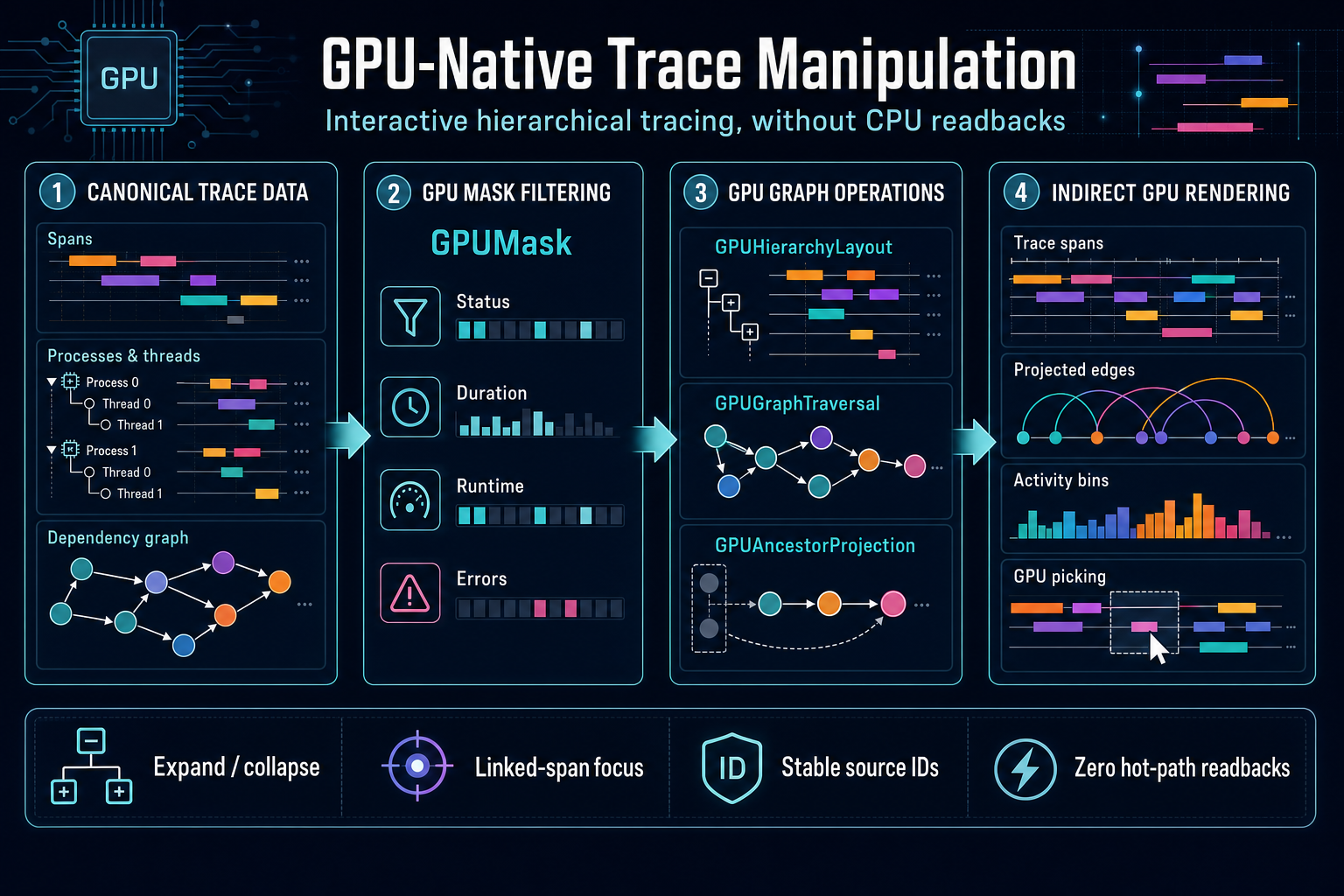
DrawCommandBuffer. The accompanying hierarchical trace viewer applies these primitives to process
and thread collapse, source and topology filtering, dependency focusing, visible-parent projection,
GPU picking, activity histograms, and indirect span and edge rendering over up to four million
spans. The sort and data-analysis examples demonstrate independent composable buffer-native
algorithms.
The implementation is intentionally experimental: it is concrete enough to measure and use, but
small enough that its API can still respond to experience.
Trace-domain scene schemas, process/thread interaction policies, dependency focus, and timeline
picking live in the optional
@luma.gl/experimental/lutrace submodule. Generic
command graphs and scene primitives remain available without importing trace-specific APIs.
The GPU frustum-culling example applies the same primitives to a conventional 3D scene. It tests bounding spheres in compute, stably compacts visible instance IDs, writes the count into an indexed indirect record, and replays fixed perspective and overhead render bundles from the same GPU-owned result. Its split view makes the culling decision observable, while its inspector compares runtime timing with compiled graph allocation statistics. Together, the examples demonstrate that the API is not specific to trace data or two-dimensional rendering.
The data-analysis example composes extent reduction, histogram counting, filtered categorical counts and means, grid binning, and weighted grid statistics in one reusable graph. It uploads Arrow columns and keeps compilation, submission, validation readback, and transient-allocation diagnostics explicit.
Why primitives instead of effects?
Rendering libraries historically grow outward from visible results. A library adds a shader for a lighting model, an antialiasing method, a new material, then a post-processing effect. Those features are easy to demonstrate because each produces an image. They are less reusable than the lower-level operations that made the image possible.
The same transition happened earlier in graphics APIs. Fifteen years ago, vertex buffers, shader programs, framebuffers, and instancing stopped being specialized implementation details and became ordinary tools. Applications could combine them without waiting for a framework to add a named effect. WebGPU creates a similar opportunity for compute and GPU-driven rendering. Storage buffers, compute dispatch, indirect commands, and explicit command recording are available, but they remain awkward to compose into reliable application subsystems.
For visualization, the reusable unit is rarely “a realistic surface.” It is more often one of the following:
- Reduce millions of values to an extent, histogram, or aggregate.
- Mark records that intersect a viewport or time range.
- Preserve the selected records in their original order.
- Expand variable-length rows into renderable vertices.
- Sort transparent objects, labels, or trace events by a key.
- Generate a bounded set of commands without inspecting each object on the CPU.
- Render stable groups whose contents change but whose pipelines and bindings do not.
- Pick an object while keeping identity aligned with the source table.
These tasks are useful separately and become much more powerful when their resource and execution contracts agree. A scan should be usable by visibility, string expansion, polygon generation, and histograms. A compacted ID vector should feed a renderer or another compute algorithm without a readback. An indirect command buffer should be writable storage and consumable by a render bundle. A graph should understand all of those uses without owning the application's frame loop.
Existing foundations
luma.gl already contains most of the raw ingredients.
@luma.gl/core exposes a WebGPU-shaped device API with buffers, textures, render pipelines,
compute pipelines, command encoders, render passes, compute passes, and render bundles. It is the
right layer for thin, portable resource wrappers. The experimental work does not replace those
objects. It composes them.
@luma.gl/engine adds shader assembly, pipeline caching, uniform management, Model, and
Computation. Computation already plays the role of a compute-oriented model: it assembles WGSL,
merges shader modules, manages bindings, and dispatches through a caller-provided compute pass.
The proof of concept uses Computation internally. A future API audit may rename or refine that
concept as ComputeKernel, but a rename is not required to evaluate command graphs.
@luma.gl/tables defines Arrow-independent GPU data structures. GPUData represents one
contiguous buffer range and its memory format. GPUVector represents an ordered list of those
ranges. GPUTable preserves row and batch structure. These types give graph buffers a common
language for formats, byte ranges, ownership, and logical row counts.
@luma.gl/gpgpu contains lazy evaluators and operations such as arithmetic, gathering, selection,
extent calculation, and bitonic argsort. Several current WebGPU handlers create a computation,
open a pass, submit it, and return a materialized result. That behavior is useful as a convenience
API, but it is not sufficient for a larger GPU-resident workflow. The command graph provides the
explicit encoding substrate that future graph-native gpgpu operations can target.
The missing center is orchestration. Before this experiment, luma.gl had no reusable object that could declare “this pass writes flags as storage; these scan passes consume scratch; this scatter pass writes visible IDs; the render pass consumes those IDs and the indirect arguments.” Without that declaration, each feature has to invent allocation, ordering, ownership, and submission rules.
The abstraction layers
The proposed system distinguishes five levels. Keeping these levels separate prevents a large
collection of unrelated classes that all happen to end in Pipeline.
Resources
Resources are memory or compiled GPU state. Buffer, Texture, TextureView, RenderPipeline,
and ComputePipeline belong here. A resource has device ownership, creation usage, and a lifetime.
A storage texture is not a separate kind of texture. It is a texture view used through a storage
binding with a declared access mode. Introducing StorageTexture as a parallel resource class
would make it harder to use the same texture as a copy destination, sampled texture, or attachment
at different points in a command stream.
Similarly, an indirect draw buffer is still a buffer. DrawCommandBuffer is a typed wrapper that
defines record layout and ownership; it does not create a second memory system.
Kernels
A kernel combines one compute shader, its layout, bindings, and dispatch. Today Computation
provides most of this behavior. A kernel is normally one graph node. It should encode into a
caller-provided pass and never decide when the queue is submitted.
The word pipeline remains reserved for compiled GPU pipeline state. Prefix sum and sorting usually
require multiple dispatches, scratch buffers, or recursively generated work. Calling those objects
pipelines would confuse multi-pass algorithms with GPUComputePipeline.
Algorithms
Algorithms provide data semantics across one or more kernels. GPUScan promises exclusive or
inclusive prefix sums, with optional segment starts. GPUCompaction promises stable selection. GPUMask promises canonical boolean
composition over source-aligned masks. GPUGraphTraversal promises bounded, cycle-safe
reachability over stable compressed sparse adjacency. GPUAncestorProjection promises bounded
nearest-visible canonical parent resolution. GPUHierarchyLayout promises stable scan-based
parent/child row offsets. GPUSort promises stable paired uint32 ordering for one packed domain,
while GPUBatchSort preserves independently allocated vector chunks as separate sort domains.
Both choose bitonic sort for smaller work units and radix sort for larger ones: domains of up to
256 rows are sorted inside one workgroup, while larger domains use stable four-bit histogram,
prefix-scan, and scatter stages. GPUSegmentedSort instead batches independent small domains
already resident in shared packed buffers, dispatching equal-width segments together without
repacking or crossing their boundaries. GPUReduction, GPUHistogram, GPUGridBinning,
GPUGridAggregation, and GPUGroupAggregation promise aggregate and binning results while
selecting hierarchical and atomic implementations internally.
The first algorithms are deliberately typed and curated. Arbitrary WGSL callbacks for compare,
combine, and predicate functions are attractive, but they significantly expand validation,
layout, shader-assembly, and portability concerns. Concrete uint32 semantics let the project
measure the graph model before designing a shader-extension protocol.
Workflows
Visibility and picking are workflows. They combine application-specific predicates, generic algorithms, render targets, and identity conventions. They should be expressed as reusable graph fragments rather than monolithic shaders.
A visibility workflow may use a frustum predicate in a 3D scene, a time/lane predicate in a trace
viewer, or a value-domain predicate in a chart. Each can write the same 0/1 flags and reuse the
same scan and compaction implementation. A picking workflow may render stable IDs, reduce a cursor
region, or traverse a spatial index. The identity and readback policies differ even when the
underlying graph machinery is shared.
Scheduling
GPUCommandGraph is the scheduling layer. It understands logical resources and their uses,
derives dependencies, compiles transient lifetimes, creates node-owned GPU objects, and records
work into an encoder. It does not own the animation loop, call requestAnimationFrame, submit the
queue, or decide when an application reads data back.
The name “command graph” is intentional. “Render graph” suggests that rendering is the primary activity with compute as a helper. Visualization workloads frequently run compute without a canvas, mix several compute stages before one render pass, or produce data for a later frame. The graph schedules render, compute, and copy commands equally.
Design principles
The proof of concept follows a small constitution. These rules matter more than the exact method names because they determine whether independently developed primitives remain composable.
Encoding is explicit
A compiled graph records into a CommandEncoder supplied by the caller. Calling encode() does
not submit the device. The application can record uploads, graph work, unrelated render passes,
and readback copies into the same ordered command stream, then submit once.
This rule also makes graphs usable inside deck.gl, an application-owned animation loop, a worker, or a compute-only service. The graph is a command producer rather than a scheduler for JavaScript.
Readback is explicit
No algorithm reads its output merely to discover how much work it produced. GPUCompaction
writes a GPU count. The trace viewer points that count directly at the instanceCount word of an
indirect draw record. Rendering proceeds without the CPU observing the count.
Applications may still read results. The trace viewer samples indirect counts at low frequency to populate its inspector, but that diagnostic readback does not affect rendering. This distinction is important: readback is an optional consumer, not a hidden step in the algorithm.
Ownership is visible
Imported resources are caller-owned. The compiled graph validates and borrows them. Destroying the graph never destroys an import.
Transient resources are graph-owned. They exist because a node declared scratch storage and are destroyed with the compiled graph. Node compilation may create computations, shaders, or pipeline state; those objects are also released by the graph.
DrawCommandBuffer can own or borrow its backing buffer. GPUData views returned for individual
count fields always borrow it. These rules avoid aggregate objects accidentally destroying storage
that remains in use elsewhere.
Capacity is structural
The graph compiles against byte lengths and logical row counts. Exceeding an imported descriptor
is an error. The graph never silently reallocates or rebuilds itself during encode().
This policy is more predictable for latency-sensitive applications. A trace viewer can choose a four-million-span capacity while loading data, compile once, and know that panning will not trigger allocation. A streaming application can monitor capacity and explicitly replace the graph at a safe boundary.
The example exposes 250K, 1M, and 4M capacities. Changing the selection intentionally destroys and rebuilds GPU resources, the render bundle, and the compiled graph. The inspector reports the compile count and time so the structural event is visible.
Uses are declared
Each node declares how it uses every graph buffer: storage read, storage write, storage read/write,
uniform, copy source, copy destination, vertex, index, or indirect. The compiler checks that the
logical resource descriptor includes the corresponding Buffer usage flag.
Declarations serve three purposes. They document a node's contract, establish dependencies, and define the lifetimes used for transient reuse. An opaque callback without resource declarations could record commands, but the graph could not safely reason about it.
Fail early
Wrong-device imports, missing usage flags, undersized buffers, invalid view ranges, duplicate IDs, missing dependencies, and cycles fail during graph construction or compilation. Per-encoding overrides are revalidated before commands are recorded.
WebGPU itself performs extensive validation, but graph-level errors can use application names and
logical capacities. “Buffer network-visible-ids is smaller than compiled capacity” is more useful
than a backend binding error emitted after several passes were recorded.
Logical buffers and typed views
A GraphBufferHandle describes a complete logical allocation. It has an ID, a required byte
length, a union of buffer usage flags, and an imported or transient lifetime. It is opaque: users
do not construct handles directly.
A GraphDataView<T> describes a typed range within a handle. Its format uses
GPUVectorFormat, and it records logical length, byte offset, byte stride, and row byte length.
Views let algorithms bind a subrange without losing table-oriented metadata.
const graph = new GPUCommandGraph(device, {id: 'filter-and-draw'});

const sourceBuffer = graph.importBuffer(
  {
    id: 'source-ids',
    byteLength: source.byteLength,
    usage: source.usage
  },
  source
);

const sourceIds = graph.createDataView(sourceBuffer, {
  format: 'uint32',
  length: objectCount
});
importGPUData() preserves one GPUData range. importGPUVector() preserves every fixed-width
chunk as an ordered GraphVectorView. The graph does not choose an execution policy for that
collection: algorithms consume individual GraphDataView chunks unless they explicitly document
vector-aware semantics. Interleaved and variable-length vectors require dedicated adapters.
Formats and shader value types remain distinct. GPUVectorFormat describes stored bytes such as
uint32, float32x3, or unorm8x4. WGSL declarations describe values such as u32 and
vec3<f32>. Algorithms validate the exact memory forms they support. The initial scan and
compaction require packed, aligned uint32 values.
Nodes and dependency compilation
The graph exposes compute, render, and copy nodes. Every node has a stable ID, declared resources,
optional explicit dependencies, and a compile callback. Compilation creates an executable callback
and may allocate node-owned resources such as Computation instances.
Dependencies are inferred in insertion order:
- A read depends on the most recent writer of that logical buffer.
- A write depends on the most recent writer.
- A write also depends on readers since the most recent write.
- A read/write use participates in both rules.
These are read-after-write, write-after-write, and write-after-read hazards. Explicit dependsOn
edges cover ordering that is not represented by a shared graph buffer. The compiler combines both
sets, rejects missing IDs and cycles, then produces a stable topological order.
Insertion order has semantic meaning when the same logical buffer is written more than once. The graph is not a functional SSA system in this proof. A later version could introduce resource versions, but ordinary command recording already uses ordered mutation, and preserving that model keeps the first API close to WebGPU.
During encoding, the graph opens and closes compute and render passes around their nodes. It applies node IDs as debug labels and debug groups. Copy nodes operate directly on the command encoder. Future compilers may merge adjacent compatible compute passes, but pass merging is an optimization, not a semantic guarantee.
Transient lifetime reuse
Multi-stage algorithms can allocate much more logical scratch memory than they need at one moment. A hierarchical scan produces block sums and block offsets at several levels. Three independent draw groups may run the same chain sequentially. Allocating a unique physical buffer for every logical scratch range is simple but wasteful.
The graph computes the first and last compiled node that uses each transient. Logical buffers with non-overlapping lifetimes can share a physical allocation. For each shared allocation, the compiler uses the maximum required byte length and the union of compatible GPU usage flags.
The current allocator is deliberately understandable. It performs interval reuse for non-mappable buffers and chooses a compatible free allocation. It does not suballocate byte ranges, alias textures, or optimize for memory heaps exposed by native APIs. WebGPU does not expose explicit memory heaps, so “aliasing” at this layer means reusing one WebGPU buffer object for logical resources whose contents are never simultaneously live.
CompiledGPUCommandGraph.stats reports both views:
- Logical transient buffer count and total bytes.
- Physical transient allocation count and total bytes.
- Bytes saved and reuse percentage.
- Final node order.
The trace viewer displays these values. They turn an otherwise invisible compiler behavior into a property developers can inspect and debate.
Prefix scan
Prefix sum, commonly called scan, is the central primitive for converting per-record decisions into
addresses. Given values [1, 0, 1, 1], an exclusive sum produces [0, 1, 1, 2]. Each selected
record can use its scanned value as a unique output offset.
GPUScan implements hierarchical exclusive and inclusive sums over packed uint32 data. Optional
nonzero segment flags restart either prefix convention. Each workgroup scans 256 values in
workgroup memory. The last aggregate from each block is written to a block-summary buffer. If there
is more than one block, the algorithm recursively scans those summaries. Offset passes then
propagate scanned block totals back down the hierarchy.
The algorithm accepts arbitrary lengths. Partial final workgroups load zero for out-of-range lanes and avoid out-of-range output writes. Non-power-of-two input lengths therefore do not need caller padding. Very large inputs create more hierarchy levels but keep the same public contract.
new GPUScan({
  id: 'visible-prefixes',
  input: visibilityFlags,
  output: visibilityOffsets
}).addToGraph(graph);
An inclusive segmented scan adds mode: 'inclusive' and a segmentFlags view. Segment flags use
the same atomic or vector topology as the input. The first logical row begins a segment; every
later nonzero flag starts another. A segment may cross vector chunk boundaries, so chunking remains
storage metadata rather than changing data semantics.
Scratch block sums and offsets are graph transients. They participate in lifetime analysis and are
released with the compiled graph. GPUScan does not allocate during encoding.
For matching GraphVectorView input and output, scan treats all chunks as one logical sequence
while keeping every caller-visible buffer and chunk boundary intact. It scans chunks locally,
scans their totals, and explicitly propagates the resulting carries across chunk boundaries.
All variants wrap modulo 2^32. Signed or floating-point sums, minimum/maximum operators, and user-defined associative operators remain deferred until they have explicit numerical and determinism contracts.
Stable compaction
Compaction takes values and 0/1 selection flags and writes only selected values to a dense
output. “Stable” means survivors retain source order. Stable identity is important for tables,
trace viewers, picking, and deterministic rendering.
GPUCompaction composes GPUScan rather than implementing a separate addressing scheme:
- Exclusively scan the flags into offsets.
- For each flag equal to one, scatter its value to
output[offset]. - Let the final invocation write
lastOffset + lastFlagas the result count.
new GPUCompaction({
  id: 'visible-objects',
  input: sourceIds,
  flags: visibilityFlags,
  output: visibleIds,
  count: visibleCount
}).addToGraph(graph);
The current operation compacts packed uint32 values. This is enough for the most important
indirection pattern: compact stable source row IDs, then let a renderer or subsequent kernel fetch
the full records. Compacting IDs also avoids copying wide records when visibility changes.
The count is an ordinary one-element graph view. It can target a standalone buffer, a field in a
larger parameter structure, or the instanceCount word inside an indirect command. Zero-length
inputs add a tiny count-clearing pass and never dispatch a zero-sized scan.
For matching vector input, flags, and output, compaction uses vector-wide scan offsets and fills the existing output chunks as one logical sequence. It does not concatenate, repack, or replace caller buffers, and the count remains a single total for the complete vector.
Candidate-driven applications can compact only active source ranges. GPUIndexedRangeCompaction
keeps one dense output sequence, while GPUPartitionedIndexedRangeCompaction preserves matching
flag and output chunks. The partitioned form scans each chunk's canonical range interval
independently, emits global source IDs into bounded destinations, and publishes both per-partition
and total counts. This lets a trace viewer move visibility scratch and visible-ID lists beyond one
storage-buffer binding without changing source identity or reading candidate counts on the CPU.
Composable visibility masks
Interactive applications rarely have one visibility predicate. A trace viewer may combine its
time range, process expansion, thread expansion, duration threshold, selected statuses, runtime
classification, and dependency-focused neighborhood. Each predicate can write a source-aligned
packed uint32 mask; GPUMask combines those decisions into one renderer-facing result.
new GPUMask({
  id: 'focused-visible-spans',
  inputs: [viewportMask, hierarchyMask, focusedSpanMask],
  output: visibleSpanMask,
  operation: 'and'
}).addToGraph(graph);
'and', 'or', 'xor', 'difference', and 'not' use zero/nonzero semantics and always
produce canonical zero or one. Matching GraphVectorView masks retain their original ordered
chunks. Composition does not repack source data, submit commands, or read back results.
Bounded graph traversal
Topology-based selection uses GPUGraphTraversal. It accepts forward and optional reverse
compressed sparse adjacency and publishes one node-aligned reachability mask.
new GPUGraphTraversal({
  id: 'selected-dependency-neighborhood',
  offsets: outgoingOffsets,
  neighbors: outgoingNeighbors,
  reverseOffsets: incomingOffsets,
  reverseNeighbors: incomingNeighbors,
  seeds: selectedSpanIds,
  seedCount: activeSeedCount,
  output: reachedSpanMask,
  direction: 'both',
  maxDepth: 4,
  activeDepth: requestedDepth
}).addToGraph(graph);
Frontiers are graph-owned transients. Atomic node claims ensure that cycles, duplicate edges, and shared descendants cannot repeatedly publish the same node. GPU-resident seed counts and active depth change the focused neighborhood without rebuilding the fixed-capacity graph.
Hierarchy-aware layout
Expansion changes both visibility and row position. GPUHierarchyLayout first converts parent
and child expansion flags into effective child heights, then composes GPUScan to produce stable
exclusive offsets.
new GPUHierarchyLayout({
  id: 'process-thread-layout',
  parentStates: processStates,
  childStates: threadStates,
  heights: threadHeights,
  offsets: threadOffsets,
  childrenPerParent: 4,
  expandedChildHeight: 4,
  collapsedChildHeight: 1,
  collapsedParentHeight: 1
}).addToGraph(graph);
A collapsed parent contributes one summary row; its remaining children contribute zero. Expanded parents retain child-specific full or collapsed heights. A renderer fetches the resulting offsets directly from storage, so expand/collapse modifies no source records or render bundle.
Visible parent projection
Filtering an intermediate parent must not sever the visual dependency between its surviving
ancestor and descendant. GPUAncestorProjection resolves every canonical node to the closest
currently visible source row without rewriting original edge data.
new GPUAncestorProjection({
  id: 'visible-dependency-endpoints',
  parents: canonicalParentIds,
  visibility: visibleSpanMask,
  output: nearestVisibleAncestors,
  maxDepth: 32
}).addToGraph(graph);
Visible nodes project to themselves. Missing parents, cycles, and chains beyond maxDepth
produce a caller-configurable invalid sentinel. Edge shaders can then redirect hidden endpoints
to visible ancestors while retaining stable original dependency IDs.
Indirect drawing and stable draw groups
WebGPU exposes drawIndirect() and drawIndexedIndirect(). Each call reads one fixed record from a
buffer. It does not currently expose an indirect-count multi-draw operation that lets a shader
generate an arbitrary number of new draw calls. This constraint shapes an honest GPU scene model.
The CPU defines stable draw groups: pipeline, geometry, bindings, and a bounded command slot. The GPU controls which object IDs appear in each group and how many instances the command draws. A render bundle can record the stable binding and indirect draw sequence once, while compute changes buffer contents every frame.
DrawCommandBuffer supports both standard layouts:
draw:         vertexCount, instanceCount, firstVertex, firstInstance
drawIndexed:  indexCount, instanceCount, firstIndex, baseVertex, firstInstance
The wrapper creates storage/indirect/copy-capable buffers, validates borrowed buffers, exposes byte
offsets, and records the correct render-pass method. getInstanceCountData() returns a borrowed
GPUData<'uint32'> over one record field.
The trace viewer imports the whole command buffer once, then creates one graph view at each
instanceCount offset. Each group compaction writes directly to its view. The final render node
declares the same logical buffer with indirect usage, so the graph infers the write-to-draw
dependency.
This model is GPU-driven without pretending WebGPU is bindless. The CPU no longer visits individual
objects, but it still owns pipeline and binding topology. Future APIs such as GPUScene should be
designed as draw databases over stable groups rather than general-purpose hierarchical scene
graphs.
The trace-viewer graph
The example synthesizes stable compute, network, and storage span ranges. Each 32-byte canonical span stores start time, duration, lane, group, process, thread, source identity, and numeric classification flags. Fixed-width dependency records preserve source and destination span IDs. Forward and reverse CSR indexes support dependency selection without string parsing or per-frame CPU adjacency construction.
At the start of each encoding, process and thread expansion buffers determine thread heights.
GPUScan converts those heights into packed lane offsets. Collapsing a process hides its
individual spans, recomputes following row positions, and exposes a GPU-binned activity summary.
Collapsing a thread retains one representative row without changing any source identity.
For each span group, the graph performs:
hierarchical visibility
  reads: canonical spans, process state, thread offsets, filters, view uniforms
  writes: base flags, source IDs, optional picked source ID

focused mask composition
  reads: base flags, dependency-reachability mask
  writes: final visible flags

scan block passes
  reads: flags or block sums
  writes: offsets and block sums

scan offset passes
  reads: block offsets
  updates: offsets

compaction scatter
  reads: source IDs, flags, offsets
  writes: visible IDs, indirect instance count
After all three span groups, dependency visibility tests canonical edge endpoints against the final span masks and collapsed-process ownership. A separate stable compaction writes the edge instance count directly to a fourth indirect draw. A fifth pre-recorded draw consumes collapsed process activity bins.
The span vertex shader uses instance_index to fetch its stable compacted source record and
resolves the current Y position from GPU-scanned thread offsets. Dependency shaders retain
original edge IDs and route collapsed endpoints to their summary rows.
Canvas picking reuses the visibility dispatch: a pointer request uploads one time and lane, and matching visible spans atomically publish a canonical source ID. Only an explicit click reads that single result. An ordinary frame does not depend on picking or count readback.
Panning, zooming, group and status filters, duration thresholds, process and thread expansion, dependency visibility, selected seeds, and focus depth update small interaction buffers or uniforms. The source allocation, compiled graph, and five-command render bundle remain stable. The inspector periodically reads indirect counts for telemetry without gating rendering.
A frame from construction to presentation
It is useful to separate work that happens when an application chooses a capacity from work that happens for every frame. The distinction is not merely an optimization. It is part of the API's predictability contract.
During construction, the application allocates its durable source buffers, visibility flags, visible-ID outputs, uniform storage, and indirect command records. It then declares the graph's logical imports. Imported descriptors state the minimum byte length and complete set of uses that the executable may require. The descriptor is a promise made by any buffer supplied later; it is not just a description of the current default buffer.
Algorithms add their own nodes and scratch declarations. At this point no GPU commands have been
recorded. GPUScan can calculate how many hierarchical levels a capacity needs and declare all
block sums and offsets. GPUCompaction can add its scatter operation and result count. The
application adds the render node after the computations that produce its inputs.
Compilation performs four conceptually separate jobs. First, it validates the closed graph: identifiers resolve, declared uses are legal for their logical resources, and explicit dependency edges exist. Second, it derives hazard edges and creates the stable node order. Third, it computes transient intervals and creates physical scratch allocations. Fourth, it invokes each node's compile callback so shaders, bind-group layouts, models, or other persistent executable state can be prepared. If node compilation fails, already-created node state and graph allocations are destroyed before the error is returned.
The application may also record a render bundle at construction time. In the trace viewer, the bundle captures three groups. Each group binds a different compacted-ID vector and color, then records one indirect draw at a fixed byte offset. The bundle refers to buffers, not snapshots of their contents. Updating IDs or instance counts therefore changes what a later execution draws without re-recording the bundle.
At frame time the CPU writes only the changing inputs. For the trace viewer these are the visible time origin, time scale, viewport size, enabled-group mask, and lane layout. A streaming consumer might also write newly arrived table chunks or a small range of dirty records. Those writes remain application operations and are not disguised as graph behavior.
The caller creates or obtains a command encoder and calls compiledGraph.encode(). Import
overrides are resolved at that moment, which is why a DynamicBuffer can replace its backing
buffer between frames. The graph validates the current backing allocation before opening a pass.
Each compute node gets a distinct compute pass in this proof. Copy nodes record directly, and the
render node opens the framebuffer pass and executes the bundle. Debug groups mirror node IDs.
After encoding returns, the command encoder still belongs to the caller. The application can add a timestamp resolve, copy three count words to a staging buffer, run a UI pass, or record commands for another subsystem. Only then does it finish and submit. This makes queue ownership obvious and allows one submission to establish ordering across graph and non-graph work.
Presentation is not a graph operation. The device or animation framework presents the canvas as it normally would. Likewise, a diagnostic readback completes through the application's ordinary asynchronous buffer API. The graph does not stall the frame to make its inspector exact.
When capacity changes, the structural lifecycle repeats. The application first stops encoding with the old executable, destroys the render bundle and compiled graph, allocates replacements, and compiles a new graph. An application may prepare a replacement before retiring the old one if it needs seamless switching, but it must own that double-buffering policy explicitly.
Hazard reasoning in practice
Hazard names can sound abstract, so consider one logical flag buffer. A visibility node declares
storage-write; a scan node declares storage-read. The scan has a read-after-write hazard and
must follow visibility. If a later clear node overwrites the flags, it has both a write-after-write
relationship with visibility and a write-after-read relationship with scan. Moving the clear
before scan would destroy data that scan still needs.
The compiler tracks the most recent writer and readers since that writer for each logical handle. A read depends on the writer. A write depends on the writer and all active readers, then becomes the new writer. This is enough for mutable, insertion-ordered command streams without inventing implicit versions of every resource.
The word logical is essential. Two views of the same handle participate in the same hazard chain, even when their byte ranges do not overlap. This is conservative. It prevents the scheduler from making a false independence claim when an application creates overlapping or strided views. A future compiler may track proven-disjoint byte intervals, but that requires range semantics for every node and brings diminishing returns for the first implementation.
Conversely, two separately imported handles that happen to reference the same physical buffer are not automatically recognized as aliases. Applications should import a physical allocation once and create views from that handle when ordering matters. The trace viewer follows this rule for the indirect command buffer: three count views and the final indirect read all derive from one logical import.
Explicit dependencies are appropriate when order is not represented by a buffer. Examples include timestamp conventions, external attachment state, a node that mutates backend state hidden inside a model, or a deliberate phase boundary used for debugging. They should not be sprinkled onto ordinary dataflow. Declared resources make the graph self-documenting and allow allocation analysis; arbitrary edges do not.
Stable topological ordering makes graph output reproducible. If several nodes are ready, their original insertion order wins. Successive writers therefore retain the order in which the builder added them. Reproducibility matters for GPU captures, generated documentation, tests, and numerical algorithms whose floating-point result can vary with association.
Pass boundaries are currently part of the compiled output. One compute node means one compute pass. This is easy to label and reason about but may not be optimal on every implementation. Later, the compiler can merge adjacent compute nodes when their semantics allow it. Such a change must preserve debug visibility and must never reorder a hazard. Applications should rely on node order, not on the number of backend pass objects.
Memory planning and pressure
Transient reuse addresses a specific source of memory pressure: algorithms that need temporary results during a bounded interval. It does not make all GPU memory virtual. Imported source data, render outputs, command records, and results that survive the graph remain durable allocations owned by their callers.
For a hierarchical scan, the first level over four million values produces about fifteen thousand block sums. Scanning those values produces another small level. Offset propagation later consumes the stored levels in reverse. Across three independent draw groups, the logical graph contains many named scratch vectors, but not all are live together. Interval reuse lets later group scratch occupy a buffer released by an earlier group while preserving distinct logical names in errors and the inspector.
Physical compatibility includes capacity and usage. A reused buffer must be at least as large as every logical tenant, and it is created with the union of required non-mapping uses. The proof uses whole-buffer reuse rather than byte suballocation. Whole-buffer reuse leaves some slack when a large allocation later hosts a small vector, but it keeps offsets simple and avoids turning the graph into a custom heap allocator before measurements justify one.
Logical and physical byte totals answer different questions. Logical bytes communicate algorithmic scratch demand: how much temporary storage would be allocated if every declaration received a dedicated object. Physical bytes approximate the actual WebGPU buffer storage retained by the compiled graph. Their difference is reported as reused bytes and percentage. A high percentage is not automatically good if it requires one oversized allocation, and a low percentage is not a failure if most data is simultaneously live. The metrics are diagnostic facts, not a score.
Fixed capacity makes memory planning meaningful. If a graph silently grew an output during encoding, compiled lifetimes and physical totals would become stale. A replacement could also invalidate render-bundle references and bindings. Explicit rebuilding turns that potentially surprising event into an observable application transition.
Memory budgets should therefore be chosen from product behavior. Interactive datasets with known upper bounds can compile to that bound. Streaming systems can use pages or batches and run the same compiled graph per page. Systems with rare growth can keep geometric capacity tiers and rebuild at controlled points. The trace viewer's three capacity choices illustrate tiers, not a universal growth strategy.
The graph owns destruction for transients exactly once, at the physical-allocation level. Logical
handles that share an allocation do not each destroy it. Imported buffers remain alive after
CompiledGPUCommandGraph.destroy(), and node-owned models or computations are released through
their executable callbacks. Idempotent destruction allows cleanup code to remain simple when
construction partially fails or a UI tears down twice.
Table-oriented integration patterns
The dependency on @luma.gl/tables is architectural. Visualization inputs are usually columns or
record batches, not anonymous byte arrays. A graph that discards logical lengths and formats at its
boundary forces every algorithm and renderer to reconstruct that information independently.
GPUData is the closest adapter because it denotes one contiguous range. Importing it creates a
logical handle for the complete backing buffer and a typed graph view for the data range. Ownership
does not transfer. Byte offset, stride, row payload size, format, and length remain visible. This
supports a packed scalar vector, a column inside a larger allocation, or a borrowed field such as
an indirect command's count word.
An offset view reveals a subtle WebGPU concern. Storage bind-group offsets have a device alignment
requirement that is commonly 256 bytes, while a typed uint32 field is only four-byte aligned. The
algorithms therefore bind the aligned containing range and add a compile-time element offset in
WGSL. This is how compaction can legally write the instanceCount at byte offset four without a
copy pass. The graph view continues to describe the precise four-byte field; binding adaptation
belongs to the kernel that knows its storage layout.
GPUVector adds chunking. Importing a fixed-width vector returns a GraphVectorView containing one
GraphDataView per source chunk. The graph preserves chunk order and shared physical allocations;
it does not concatenate, copy, or dispatch work automatically. Algorithms still declare atomic
GraphDataView resources, so accepting a GraphVectorView is an explicit algorithm-level choice.
Interleaved and variable-length vectors remain rejected until dedicated adapters define attribute
and topology semantics.
A batch-aware graph API can offer explicit choices. A map-style algorithm may instantiate a graph fragment for every chunk. A streaming scan may produce a per-chunk total, scan those totals, then add carries. An application that truly needs contiguous storage can call a named packing operation and account for its allocation. All three are useful, and none should be selected merely because an adapter received a multi-chunk vector.
GPUVectorFormat describes stored bytes. It deliberately does not claim that every memory format
can be bound to every shader declaration. A normalized unorm8x4 column occupies four bytes but
may appear to a vertex shader as vec4<f32>. A packed float32x3 occupies twelve bytes, while a
corresponding structure member in a WGSL storage layout may require sixteen-byte alignment. Graph
views preserve memory truth; kernels and model adapters validate shader compatibility at the
boundary where usage is known.
Variable-length formats such as vertex-list<float32x3> need topology metadata and expansion
policy. A generic graph view can carry the format string and flattened value count, but a renderer
cannot treat its logical rows as fixed-stride vertices. Future graph-native path or polygon
workflows should consume offsets explicitly, use scan to allocate expanded output, and expose the
result as a fixed renderable vector.
GPUTable integration should preserve record-batch boundaries for streaming. A table-oriented
workflow can declare required columns, validate equal row counts, and build one graph invocation
per batch or a graph with explicit batch descriptors. This is where the tables package graduating
into engine in v10 becomes valuable: core orchestration and core GPU data containers can share
types without Arrow becoming a transitive dependency.
Arrow remains an adapter layer. Upload helpers can map Arrow primitive, list, dictionary, and validity representations into table objects. Readback helpers can reconstruct Arrow arrays when an application asks. Neither graph compilation nor scan should import Apache Arrow or use Arrow data types as its primary GPU metadata.
Operational guidance for graph authors
Graph fragments should have narrow, inspectable contracts. Accept views and configuration, add named nodes, and return output views or handles that callers can compose. Avoid hiding imports, submissions, or readbacks inside a helper. A fragment that needs scratch should declare transients with IDs derived from its own stable ID so captures remain understandable when several instances exist.
Declare every use, including uses that do not appear as shader bindings. An indirect command read, vertex fetch, index fetch, copy source, and copy destination all affect order and required creation flags. A render node that binds visible IDs as storage and draws from a command buffer should list both. Omitting the command buffer might render correctly by accident in a fixed insertion order, but it removes the dataflow edge and makes later graph changes unsafe.
Prefer compact IDs over compact wide records. IDs are inexpensive to scan and scatter, preserve a stable identity space, and let multiple consumers fetch only the columns they need. They also keep picking results aligned with source tables. Compacting full records is appropriate when downstream access would otherwise be badly scattered, but that should be an explicit transformation with a declared output schema.
Keep result counts GPU-resident when they control GPU work. An indirect instance count, a dispatch argument, or a later algorithm bound should flow through storage or indirect buffers. Read it only for application decisions that genuinely belong on the CPU. A telemetry panel is not a reason to put a readback into the render dependency chain.
Treat limits and overflow as API behavior. A uint32 scan wraps modulo 2^32. A compaction output
must have at least the input's logical capacity even if typical visibility is low, unless the API
defines overflow handling. Dispatch dimensions must respect device limits. More advanced
algorithms may need tiled dispatch or 64-bit emulation; the proof keeps its supported domain
explicit rather than promising unbounded work.
Use debug names as part of design, not as decoration added after a failure. Node IDs should describe
the domain and operation, such as network-visibility or storage-compaction-scan-level-1. Buffer
IDs should describe content rather than implementation variables. These names appear in validation
messages, browser diagnostics, captures, and the graph inspector.
Graph authors should also consider where parameter specialization belongs. Capacity is compiled into scan and compaction shaders in this proof, which removes a uniform read from hot kernels and makes bounds obvious. View origin, zoom, and group enablement change every frame and belong in a uniform buffer. Specializing a frequently changing value would force expensive recompilation; turning every structural constant into a uniform would weaken validation and optimization.
Finally, keep a CPU oracle in tests even when production has no CPU fallback. A deterministic CPU scan or filter is ideal for verifying GPU results across boundary sizes and random masks. The oracle does not weaken the WebGPU-only product posture; it supplies a precise test expectation. End-to-end tests should additionally verify that changing a GPU-written indirect count changes rendering without a CPU-side draw branch.
Choosing names that can survive v10
Names should expose the durable concept rather than the current shader technique. GPUScan
describes an algorithmic result. PrefixSumPipeline would collide with WebGPU pipeline
terminology and imply that one pipeline object performs the full hierarchy. GPUCompaction
describes stable selection and leaves room for different kernels.
DrawCommandBuffer names a typed resource wrapper. IndirectDrawBuffer is understandable, but it
can suggest that the buffer supports only consumption. In practice the important property is that
compute can write well-defined command records that render passes consume indirectly. The wrapper
therefore exposes record layout, count views, and encoding helpers together.
GPUCommandGraph is broader than RenderGraph. Scientific workflows may never open a render pass,
and a trace viewer performs most of its work in compute. The word command also reinforces that the
output is encoding into a caller's command stream rather than an automatically submitted frame.
Terms such as VisibilityPipeline and PickingPipeline are better treated as workflows unless a
specific object truly wraps one compiled backend pipeline. Visibility combines a domain predicate,
scan, compaction, counts, and sometimes level-of-detail selection. Picking combines identity
rendering, region selection, reduction, and explicit readback. Workflow objects can assemble graph
fragments while reusing the underlying algorithms.
Likewise, GPUAccelerationStructure is too broad for today's WebGPU. It can be confused with
native ray-tracing objects that the web API does not expose. Concrete names such as GPUGridIndex,
GPUBVH, or GPUIntervalIndex reveal the data structure, construction cost, and queries an
application can expect. Their buffers and build/traversal algorithms can still compose through the
same graph.
This naming discipline is meant to keep public types small. luma.gl does not need one class for every impressive demo. It needs a vocabulary in which resources, kernels, algorithms, workflows, and scheduling have distinct meanings and can evolve independently.
Error handling and debugging
The experimental API favors named, early errors:
- A graph constructed with a non-WebGPU device is rejected.
- Buffer and node IDs must be unique.
- Descriptors require safe non-negative byte lengths and nonzero usage.
- Views must fit inside their logical buffers.
- Algorithm views must be packed and aligned in the supported format.
- Per-encoding overrides must match the compiled capacity and usage.
- Imports from another device are rejected by resource consumers and core indirect validation.
- Explicit dependencies must name existing nodes.
- Cycles fail compilation.
- A graph cannot be mutated or compiled again after compilation.
- A destroyed executable cannot encode.
Node IDs become compute/render pass labels and nested debug groups, making browser GPU captures match graph documentation. The next instrumentation step is optional timestamp allocation per node. Timestamp support should remain capability-gated and should not force readback during normal encoding.
Backend policy
These APIs require WebGPU. They do not emulate compute with transform feedback or textures on WebGL2. Existing luma.gl rendering and table APIs continue to support WebGL where appropriate, but the advanced tier is allowed to expose capabilities that only make sense in WebGPU.
This separation avoids a lowest-common-denominator graph. WebGL command execution is effectively immediate, has no compute pass, and cannot consume WebGPU indirect records. A portable facade would need CPU mediation exactly where the architecture is trying to preserve GPU residency.
Applications should feature-detect WebGPU and choose a separate product fallback when necessary.
Individual high-level workflows may provide CPU or WebGL implementations, but those fallbacks are
not part of GPUCommandGraph semantics.
Package evolution
The proof lives in @luma.gl/experimental so graph contracts, naming, allocation behavior, and
algorithm ergonomics can change together. It depends on @luma.gl/tables because typed GPU ranges
are central to the design, not an optional adapter.
The intended v10 layering is:
@luma.gl/engine
  table-independent command-graph scheduling core
  buffer, texture, retained texture history, pass, and generic graph views
  compute/render kernel integration without a tables dependency

@luma.gl/tables
  GPUData, GPUVector, GPURecordBatch, GPUTable, GPUSchema, GPUVectorFormat
  GPU table and vector adapters for graph views

@luma.gl/gpgpu
  GPUScan, GPUCompaction, and reusable visibility workflows
  GPUMask, GPUHierarchyLayout, GPUGraphTraversal, GPUAncestorProjection
  GPUReduction, GPUSort, GPUBatchSort, GPUSegmentedSort
  GPUBVH, GPUSegmentedBVH
  GPUHistogram, GPUGridBinning, GPUGridAggregation
  GPUGroupAggregation
  GPUHashIndex, GPUHashIndexQuery, GPUHashJoin, and GPUBatchHashJoin
  higher-level table algorithms

@luma.gl/arrow
  Arrow upload, conversion, and readback adapters
Generic GPU table types remain owned by @luma.gl/tables; moving them into engine would reverse the
current package dependency and create a cycle. A graduated command-graph core must therefore use
only core resource concepts. Table-to-graph adapters stay with tables, while optional algorithms
and workflow builders move to gpgpu. DrawCommandBuffer needs the same audit: an engine-level core
cannot import GPUData, so its final placement or split remains part of graduation rather than a
predeclared stable contract.
The graph already has three independent consumers. Graduation now requires each candidate stable abstraction—not only the graph as a whole—to be exercised by at least two consumers. The trace viewer proves two-dimensional filtering and rendering. The frustum-culling field adds bounding-sphere visibility, indexed indirect drawing, and a moving three-dimensional camera. The data-analysis example adds Arrow columns, scientific reduction, histogram composition, and spatial counts. Later consumers should exercise different patterns such as text expansion or path tessellation.
Phased roadmap
The command-graph foundation and hierarchical-trace, analysis, texture, picking, and spatial filtering v1 milestones are implemented. The remaining work is ordered by dependency so that later APIs build on measured, reusable contracts instead of demo-specific behavior.
Impact estimates how broadly a phase unlocks GPU-driven applications. Complexity/cost estimates relative engineering scope, integration risk, and validation effort; it is not a staffing or schedule commitment.
| Phase | Outcome | Status | Impact | Complexity/cost |
|---|---|---|---|---|
| 0 — Current foundation | Command graph, masks, hierarchy layout, graph traversal, ancestor projection, compaction, indirect drawing, picking, analysis primitives, and three working consumers | Implemented | High | Complete |
| 1 — Hardening and observability | GPU timestamps, performance baselines, adapter capability reporting, boundary and overflow validation, memory statistics, and device-loss and resource-lifetime coverage | Implemented | High | Medium |
| 2 — Reusable visibility workflows | Renderer-independent time-range, bounds, LOD, and selection workflows that publish stable IDs, counts, and indirect commands | Implemented | High | Medium |
| 3 — Algorithm and table scaling | Multi-chunk coverage, segmented and inclusive scans, weighted statistics, richer histograms, and batch-preserving algorithms | Core implemented; topology extensions deferred | High | Large |
| 4 — Picking and texture coverage | Region picking, asynchronous staging rings, multisample resolves, frame-scoped swapchain imports, and sampled-only external-image contracts | Implemented | Medium | Large |
| 5 — Spatial acceleration | GPUGridIndex and GPUBVH with explicit build, update, query, correctness, and cost-comparison contracts | V1 implemented; conditional extensions deferred | High | Large |
| 6 — GPUScene | A flat GPU draw database with stable identity, bounds, transforms, grouping, geometry references, and indirect command slots | Storage, mutation, source adapters, draw generation, and resource grouping implemented; cross-domain consumers planned | High | Large |
| 7 — API graduation | Stable package contracts and a dependency-safe direct move out of experimental packages | Planned | High | Large |
Spatial v1 milestones
Phase 4 is implemented through Tranche 4.4. The spatial stack now includes compact 2D/3D
GPUGridIndex construction, conservative queries, exact point refinement with an unindexed GPU
oracle, deterministic complete-binary GPUBVH storage and refit, and exact BVH bounds/point
traversal. These are foundations, not a claim that incremental grid updates or source-order BVH
topology are always profitable. A shared benchmark harness now rejects incomplete or incorrect
paths before reporting timings and records why optional update, topology, and ray extensions remain
deferred.
| Milestone | Implemented outcome |
|---|---|
5.1a — GPUGridIndex build | Stable cell offsets and capacity-bounded IDs for packed 2D/3D points |
5.2a — GPUGridIndex query | Point, bounds, and radius cell candidates with masks, counts, and overflow |
| 5.2b — Exact query consumers | Indexed and unindexed 2D/3D point predicates feeding one visibility contract |
5.3a — GPUBVH storage and refit | Flat complete-binary nodes, stable leaf slots, explicit capacity, and bottom-up refit |
5.4a — GPUBVH bounds and point query | Exact 2D/3D traversal with stable IDs, masks, count, overflow, and visited-node metrics |
| 5.2c / 5.4c — Benchmark and cost model | Correctness-gated scan/grid/BVH timings, phase distributions, memory, work counters, and reuse amortization |
| 5.1b / 5.3b / 5.4b — Decision gates | Incremental grid updates, topology rebuild, and ray traversal deferred pending consumer semantics and positive evidence |
Remaining tranche map
The first larger-compute slice can proceed independently of package graduation because it uses the
existing table-independent graph contract. Tranche 8.1a is implemented: GPUHashIndex rebuilds a
fixed-capacity sparse uint32 identity map from one packed batch, GPUBatchHashIndex builds the
same shared map from preserved right-side chunks without concatenation, and GPUHashIndexQuery
performs bounded lookup against either index with deterministic duplicate values, explicit invalid
and overflow counts, and probe statistics.
Tranche 8.2a is also implemented: GPUHashJoin composes lookup and stable scan into bounded
many-to-one row-pair materialization with exact required-count and overflow reporting. It
propagates incomplete source indices rather than presenting partial matches as complete. Tranche
8.3a adds GPUBatchHashJoin: ordered left chunks independently query one shared right index and
retain per-batch capacities, counts, overflow, and probe statistics without packing. The current
contracts intentionally stop before deletion, independently partitioned right indices, multi-match
joins, and payload materialization establish their own consumer-driven contracts.
The remaining work is divided into reviewable contracts. A tranche should land only when its entry dependency is present and its measurable exit evidence can be produced. Numbering groups related contracts; table order and the recommended sequence express dependency order, not staffing or schedule commitments. Conditional implementation tranches are entered only when the preceding decision gate shows that their added memory and complexity pay for themselves in representative consumers.
| Tranche | Outcome | Entry dependency | Measurable exit | Impact | Cost |
|---|---|---|---|---|---|
| 8.1b — Mutable hash maintenance | Deletion and tombstone or rebuild-threshold policy grounded in a dynamic consumer | Implemented bounded GPUHashIndex build/query plus measured mutation workload | Lookup parity across deletion and reinsertion; bounded degradation and explicit rebuild trigger | Medium | Medium |
| 8.2b — Sparse grouping and multi-match decision | Decide sparse aggregate rows, one-to-many storage, and payload materialization separately | Implemented bounded many-to-one GPUHashJoin plus two requesting consumers | Each expansion contract is accepted with output bounds and CPU-oracle evidence or explicitly deferred | High | Large |
| 8.3b — Partitioned-right decision | Decide paired partitions, key routing, or global addressing for multiple right indices | Implemented shared-right GPUBatchHashJoin plus a consumer with partitioned right ownership | One routing contract is accepted with empty/uneven batch evidence or explicitly deferred | High | Large |
| 8.4 — Sparse graph analytics | Frontier/visited representations and graph algorithms selected by demonstrated consumers | Partitioned identity contracts from 3.2 and the 8.3b decision | Bounded CPU-oracle parity on disconnected, cyclic, and high-degree graphs | High | Large |
| 8.5 — Field and solver composition | Reusable graph-native stencil, advection, and solver building blocks behind live simulations | Two existing simulation consumers agree on field and boundary contracts | Shared primitives replace consumer-local kernels without hidden submission | High | Large |
| 3.2 — Partitioned topology | Implemented: global-ID and chunk-base contracts for hierarchy and CSR inputs without hidden packing | Implemented Phase 3 primitives plus a preserved-batch consumer | CPU-oracle parity across empty and uneven chunks; no implicit repack | High | Large |
| 3.3 — Extension decision gate | Implemented: sparse/multidimensional histograms, custom scans, and shader predicates explicitly deferred pending consumer evidence | Tranche 3.2 plus at least two requesting consumers | Each proposal is accepted with a fixed contract or explicitly deferred with evidence | Medium | Small |
| 6.3a — Conventional scene consumer | Implemented: an application-owned CPU scene graph uses shared flat storage, GPU visibility and picking, renderer resource groups, measured mutation, and indirect draw generation | Tranche 6.2b and Phase 4 | Stable application IDs, one compiled graph, explicit update costs, and no consumer-specific fields or CPU draw filtering | High | Medium |
| 6.3b — Table-oriented scene consumer | A preserved-batch table application uses the same runtime contracts | Tranches 6.1c, 6.2b, and 3.2 | Shares public primitives with 6.3a without repacking or adapter casts | High | Medium |
| T.1 — Canonical GPU trace scene | Stable spans, process/thread ownership, preserved source partitions, parents, dependency CSR, and generic scene projection | Implemented GPUScene, draw generation, and renderer-owned resource groups | Source identity, empty/uneven batches, bidirectional links, ownership, and scene draw/group integration pass GPU tests | High | Medium |
| T.2 — Interactive GPU trace policies | Implemented: time windows, process/thread expansion, linked-span focus, ancestor retention, and stable indirect draws | Tranche T.1 plus hierarchy, mask, traversal, and visibility workflows | Policy-only updates reuse one graph with GPU-tested stable masks, row IDs, hierarchy offsets, ancestry, and indirect draws | High | Large |
| T.3 — Scene-backed trace showcase | Implemented: a bounded live trace explorer combines canonical trace scenes, GPU interactions, picking, resource groups, stable indirect drawing, and command-graph inspection | Tranche T.2 plus existing picking and graph-inspection contracts | Representative traces pan, filter, collapse, focus, and pick without CPU draw selection or graph recompilation | High | Large |
| 7.1 — Dependency audit and API freeze | Freeze names, ownership, failures, capacities, submission, and package graph | Phase 6 exits and two consumers per graduation candidate | Acyclic dependency report and owner for every public resource boundary | High | Medium |
| 7.2 — Scheduling-core extraction | Move table-independent graph scheduling directly to @luma.gl/engine | Tranche 7.1 | Engine builds without tables, gpgpu, or Arrow; all repository imports use the final owner | High | Large |
| 7.3 — Adapter and algorithm migration | Keep table adapters in @luma.gl/tables; move optional workflows to @luma.gl/gpgpu | Tranche 7.2 | Package tests enforce dependency direction and examples use final owners | High | Large |
| 7.4 — Documentation and graduation | Stable docs, release notes, and experimental-removal criteria | Tranche 7.3 | API reports and links pass; obsolete experimental exports are absent | High | Medium |
Recommended execution order
- Add the preserved-batch table consumer (6.3b) beside the implemented conventional scene consumer (6.3a) to prove the same shared visibility, picking, generated draws, and renderer-owned resource groups without packing or consumer-specific scene fields.
- Preserve the implemented canonical trace-scene, reusable interaction, and live scene-backed showcase contracts (T.1–T.3); add larger trace features only when a consumer establishes their resource bounds and measurable benefit.
- Preserve the implemented partitioned hierarchy/CSR topology and explicit extension decision gate (3.2–3.3); reopen extensions only when new consumers fix their memory and identity costs.
- Reopen incremental grid maintenance, spatial BVH rebuild, or ray traversal only when the documented decision gate gains a requesting consumer and positive evidence.
- Graduate packages only after both scene consumers prove the final APIs and dependency direction.
- Develop the larger compute vocabulary independently where contracts are already bounded:
single-batch
GPUHashIndex, preserved-right-batchGPUBatchHashIndex, bounded many-to-oneGPUHashJoin, and shared-rightGPUBatchHashJoinare implemented; require consumers and measurements before adding mutable maintenance, partitioned-right routing, multi-match joins, sparse graph algorithms, or generalized field solvers.
Phase 0 — Current foundation
Entry dependencies: None. This is the implemented baseline.
The baseline includes fixed-capacity buffer and logical-texture scheduling across compute, render, and copy nodes; hazard inference; imported-resource overrides; graph-owned attachments; transient reuse; ownership validation; and allocation statistics. Implemented algorithms cover exclusive, inclusive, and segmented scans; stable compaction; chunk-preserving boolean masks; bounded CSR traversal; nearest-visible parent projection; paired sort; scalar reduction; histogram counting; spatial grid binning; and GPU-written indirect commands.
GPUIndexPickingTarget provides single-pixel and bounded-region integer object and batch picking;
GPUReadbackRing overlaps reusable staging slots without mapped-buffer reuse. The hierarchical
trace viewer adds GPU-scanned process/thread layout, source and topology filtering, dependency
focus, click picking, collapsed activity, projected edges, and stable indirect span and edge groups.
The frustum-culling and GPU data-analysis examples provide two additional consumers.
Exit criteria: Achieved by the current exported primitives, reference documentation, CPU oracles, WebGPU tests, and the three independent examples.
Phase 1 — Hardening and observability
Status: Implemented in the experimental API.
Entry dependencies: Phase 0 behavior remains experimental but functionally complete.
Add capability-gated timestamp allocation per graph node without adding readback to normal encoding. Establish repeatable performance and memory baselines for empty inputs, workgroup boundaries, maximum example capacities, dense dependency graphs, and repeated parameter-only updates. Extend adapter diagnostics, capacity and overflow tests, device-loss handling, and resource-lifetime coverage.
CompiledGPUCommandGraph.capabilities reports graph-relevant adapter support and limits. Expanded
stats account for imported, logical, and owned transient memory. Every encode() returns
synchronous whole-graph and per-node CPU costs; timestamp-enabled encoders additionally support an
explicit post-submit readTimings() call. The documented benchmark protocol covers boundary and
maximum example capacities without making readback part of the frame loop.
Exit criteria: Achieved by capability reporting, encoding and timestamp diagnostics, expanded memory statistics, safe-range and adapter-limit validation, device-loss rejection, lifecycle tests, and the repeatable benchmark protocol.
Phase 2 — Reusable visibility workflows
Status: Implemented in the experimental API.
Entry dependencies: Phase 1 establishes measurement, failure, and lifetime contracts.
Standardize graph fragments for bounding spheres, axis-aligned boxes, time ranges, LOD thresholds, and selection masks. A workflow publishes source-aligned masks, compacted stable IDs, counts, and optional indirect-command fields rather than a renderer-specific object. Refactor the trace viewer and frustum-culling example to consume the same workflow contract.
General application-defined WGSL predicates remain deferred until fixed-contract workflows reveal the necessary shader-extension points.
GPUVisibilityWorkflow now accepts source-aligned time-range, bounds, LOD, and selection masks,
intersects them, optionally publishes the canonical mask, generates or consumes stable source IDs,
and writes compacted IDs plus one GPU-resident count. Atomic and multi-chunk vector inputs share
the same contract. The hierarchical trace viewer and frustum-culling example both use the workflow
and send its count directly to indirect rendering; changing view and selection data does not
recompile either graph.
Exit criteria: Achieved by two consumers sharing one workflow without application-owned scan or compaction plumbing, parameter-only interaction updates on compiled graphs, and GPU-resident counts flowing directly into indirect rendering.
Phase 3 — Algorithm and table scaling
Status: Implemented. Inclusive and segmented uint32 scans, weighted floating-point grid and
categorical statistics, irregular-edge histograms, filtered categorical counts, batch-preserving
paired sort, and partitioned hierarchy and CSR topology are implemented.
Entry dependencies: Phase 2 provides real workflow demand for each added variant.
GPUScan now supports inclusive output and nonzero segment-start flags for both atomic data views
and chunk-preserving vectors. Segments continue across chunk boundaries, hierarchical summaries
preserve carry-in values when a later row starts a segment, and all arithmetic retains the
documented modulo-2^32 behavior. The data-analysis example uses inclusive scan for a histogram CDF
and a segmented inclusive scan for per-row spatial-grid prefixes.
GPUGridAggregation pairs float32x2 positions with aligned float32 weights and computes one
row-major sum, minimum, maximum, or mean per cell. Atomic data views and vectors with identical
chunk topology share the same initialize-once contract. Non-finite positions and weights are
ignored. Sum and mean use compare-exchange addition with explicit nondeterministic float32
accumulation order; minimum and maximum use ordered float encodings with native integer atomics.
Empty non-sum cells publish NaN. The data-analysis example validates all four operations over the
same imported Arrow batches.
GPUHistogram now supports literal and GPU-resident irregular edges in addition to equal-width
domains. It uses binary search with [edge[i], edge[i + 1]) intervals and includes the final upper
edge. GPU edges are validated for finite, strictly increasing order by a graph pass, so applications
can update thresholds between encodings without a CPU readback or graph rebuild. Invalid GPU edges
produce zero counts. The data-analysis example switches between uniform and GPU-resident threshold
bins and validates both against a CPU oracle.
GPUGroupAggregation maps dense uint32 identity codes directly to caller-owned group rows. Count
uses a uint32 output; aligned float32 values add sum, minimum, maximum, and mean outputs with the
same finite-value and empty-result contracts as grid aggregation. An optional source-aligned mask
lets visibility or selection workflows update categorical distributions and statistics without
downloading selected IDs. Atomic and vector inputs share one contract; vectors preserve aligned
source chunks without packing. Large chunks use bounded three-dimensional dispatches. The
data-analysis example groups the same Arrow rows by quadrant while a selectable value mask changes
both the accepted population and its per-group means.
GPUBatchSort applies stable paired uint32 sorting independently to aligned GPU vector chunks.
It preserves the number, order, and length of source batches, never allocates a hidden packed
copy, and selects bitonic or radix sorting independently for each chunk. This supports streaming
record batches, per-tile ordering, and incremental ingestion where partition boundaries are part
of the storage and lifetime contract. The GPU sort example contrasts that behavior with one
explicit packed global sort and validates independently sorted batches against a CPU oracle.
GPUSegmentedSort addresses a different partition contract: many small domains already occupy
shared parent key and payload buffers. Explicit per-domain offsets and lengths retain segment
boundaries while equally sized workgroups share one dispatch. Segments of up to 256 rows require
at most eight width-bucket graph nodes regardless of segment count; gaps remain untouched and no
hidden packing or physical allocation occurs. This is useful for independent mesh-local Morton
orders, while separately allocated streaming chunks remain the domain of GPUBatchSort.
More batch-aware operations remain consumer-driven rather than being required to complete this phase. Custom associative scans, sparse histograms, and multidimensional histograms should be added only with a concrete consumer and an explicit numerical or memory contract.
Tranche 3.2 — Partitioned topology
Status: Implemented.
Define how chunk-local rows map to stable global IDs, including explicit base offsets and the ownership of cross-chunk hierarchy or CSR edges. Extend at least one hierarchy primitive and one CSR primitive to consume that contract without concatenating chunks behind the caller's back.
GPUHierarchyLayout now derives stable cumulative bases independently for parent and child
vectors, splits only the intersecting work when their boundaries differ, and scans offsets across
the preserved child topology. GPUGraphTraversal accepts one local CSR allocation per output
partition with global neighbor IDs and routes arbitrary cross-partition edges through explicit
source-to-target passes. The trace viewer exercises both contracts using two logical partitions
backed by its existing allocations.
Exit evidence: CPU-oracle tests cover empty chunks, cross-chunk references, uneven boundaries, and incremental replacement of one batch. A hierarchy and graph consumer preserve their source partitions while producing the same IDs and results as an explicitly packed input.
Tranche 3.3 — Extension decision gate
Status: Implemented as an explicit deferral decision.
Evaluate custom associative scans, sparse and multidimensional histograms, and shader predicate callbacks against demonstrated consumers after partitioned topology lands. Each candidate must state its numerical behavior, memory-growth bounds, composition model, and why existing fixed contracts are insufficient. Explicit deferral is a valid outcome; this tranche does not require inventing an extension API merely to complete a checklist.
| Candidate | Decision | Evidence required to reopen |
|---|---|---|
| Custom associative scans | Defer | Two consumers sharing an associative operation, identity value, overflow behavior, and shader value layout that the fixed uint32 scan cannot express |
| Sparse histograms | Defer | A high-cardinality consumer where dense output is demonstrably the dominant memory cost, plus bounded key storage and overflow semantics |
| Multidimensional histograms | Defer | Two consumers requiring joint distributions that cannot compose GPUGridBinning, GPUGridAggregation, or dense group IDs without materializing an avoidable column |
| Application WGSL predicate callbacks | Defer | Two visibility consumers sharing binding, validation, cache-key, diagnostic, and composition requirements beyond the fixed workflow masks |
This decision keeps numerical behavior and shader interfaces inspectable. A future proposal should name the missing fixed-contract capability and its capacity bound rather than exposing an unconstrained callback as a shortcut.
Exit evidence: Every candidate has two motivating consumers or remains documented as deferred, and any accepted API has a CPU oracle plus explicit capacity, overflow, and shader-compatibility contracts.
Irregular histogram edges primarily target heavy-tailed measurements such as trace duration and request latency. Explicit microsecond-to-second boundaries preserve resolution across orders of magnitude, align results with service-level thresholds, and let applications compare dynamic filtered subsets without first generating a log-transformed column. The histogram reference documents the use case, interval semantics, and update contract.
Exit criteria: Each new variant has a deterministic CPU oracle, empty and boundary coverage, multi-chunk tests where applicable, explicit overflow and floating-point behavior, and at least one application or renderer consumer.
Phase 4 — Picking and texture coverage
Entry dependencies: Phase 1 defines resource-lifetime and asynchronous readback behavior; Phase 2 defines stable visible identity.
Region picking, reusable asynchronous staging-buffer rings, multisample resolves, frame-scoped swapchain imports, and sampled-only external-image imports are implemented. Their access, ownership, and asynchronous or frame lifetime are explicit. Callback, highlighting, tooltip, and color-encoded fallback policies remain higher-level workflow or application concerns.
Tranche 4.1 — Region picking
GPUIndexPickingTarget.addRegionPass() publishes object IDs, batch IDs, a total result count, and
an overflow flag into caller-sized GPU storage. One covered pixel produces one pair, duplicates are
preserved, and atomic append order is unspecified. Selection semantics such as nearest-only,
toggling, deduplication, or highlighting stay above the primitive.
Exit evidence: Tests cover empty regions, overlapping primitives, duplicate IDs, exact capacity,
and overflow. An example uses stable IDs from GPUVisibilityWorkflow without a CPU-side identity
translation.
Tranche 4.2 — Asynchronous readback ring
GPUReadbackRing provides reusable staging tickets with immediate and waiting acquisition paths,
explicit cancellation, safe mapped-buffer reuse, destruction, and device-loss propagation. It owns
staging allocations but neither submits command buffers nor silently waits for a mapped slot.
Exit evidence: Repeated region picks can overlap rendering and readback without reusing a mapped buffer or serializing every frame. Tests cover ring exhaustion, out-of-order completion, cancellation, destruction, and device loss.
Tranche 4.3 — Render-target graph contracts
Graph render attachments now model multisample resolve targets with explicit mip, layer, aspect,
access, format, extent, and sample validation. importFrameTexture() requires caller-acquired
swapchain textures to carry one coherent, strictly increasing frame ID per encoding. The graph
validates hazards but never acquires, presents, or destroys a swapchain texture on the
application's behalf.
Exit evidence: Compute, render, copy, and resolve nodes order conflicting subresource access; multisample and swapchain examples encode through the graph; invalid same-pass access, stale-frame, and ownership mistakes fail before submission.
Tranche 4.4 — External-texture contracts
importExternalTexture() represents external images as a distinct sampled-only resource rather
than pretending they are ordinary texture storage. Each encoding requires a fresh concrete
binding and a strictly increasing frame ID coherent with every other frame resource. Render nodes
resolve the current snapshot through getExternalTexture(); views, storage, copies, attachments,
and graph ownership are deliberately unavailable. Media scheduling, frame acquisition, and
fallback conversion stay outside the graph.
This boundary matters for video, camera, and browser-compositor sources. Their native WebGPU path
can avoid a per-frame copy, but the resulting texture_external binding is opaque and short-lived.
Making that lifetime explicit prevents an application from caching yesterday's browser binding or
accidentally routing it through APIs that require reusable texture memory. The video-texture
example demonstrates successive native bindings while retaining an explicit copied WebGL fallback.
Exit evidence: Validation prevents persistence into incompatible compiled encodings; common device-loss checks cover encoding; replacement, cross-resource frame coherence, stale IDs, fresh binding identity, and borrowed destruction are tested; and the video-texture consumer imports successive native frames without graph-owned destruction or accidental cross-frame reuse.
Exit criteria: Region results preserve stable object and batch identity; repeated picks do not serialize rendering on mapped buffers; and resolve, swapchain, and external resources participate in graph validation without accidental ownership or cross-frame reuse.
Phase 5 — Spatial acceleration
Entry dependencies: Phase 1 supplies measurement, Phase 2 supplies reusable visibility, and Phase 3 supplies the required scan, compaction, and batching behavior.
GPUGridIndex was implemented before GPUBVH to validate build, update, storage, and query
interfaces on a simpler structure. Grid-index consumers established the shared identity, capacity,
overflow, and measurement contracts reused by BVH traversal. Both are library-built storage-buffer
structures, not native WebGPU acceleration resources, and expose their construction and query
costs.
Tranche 5.1 — GPUGridIndex build and update
Status: Compact full-build storage is implemented. Incremental maintenance is deferred pending a moving-data consumer and a positive measured update-policy decision.
Build a flat index of cell offsets and stable object IDs from bounded positions or bounds. Expose capacity and overflow, distinguish full rebuilds from supported incremental updates, and keep cell size and domain policy caller-controlled.
GPUGridIndex builds 2D float32x2 or 3D float32x3 point inputs into exclusive row-major cell
offsets and capacity-bounded stable IDs. It accepts one packed view or preserved vector chunks,
generates logical IDs or consumes aligned explicit IDs, and reports the full accepted count plus
overflow without writing past capacity. Exact maximum coordinates enter the final cell; non-finite
and out-of-domain rows are ignored.
The current update policy is explicitly 'rebuild': callers may upload a bounded input range or
replace one vector chunk, but the next encoding clears, scans, and scatters the complete compact
index. The 5.1b decision gate deferred bounded relocation and reserved-cell designs because no
moving-data consumer yet demonstrates a positive crossover after memory overhead, fragmentation,
adversarial movement, and overflow behavior. Tranche 5.1c reopens only if that evidence justifies an
incremental design; 'rebuild' is the complete v1 policy.
Implemented evidence: Two-dimensional and three-dimensional builds match CPU oracles across empty, clustered, out-of-domain, and capacity-boundary inputs.
Decision: Full rebuild is the supported v1 update contract. The benchmark reports its build cost separately from query cost. Bounded relocation or reserved-cell maintenance reopens only when a moving-data consumer demonstrates a crossover that repays added memory, fragmentation, and overflow complexity.
Tranche 5.2 — GPUGridIndex query
Status: Conservative queries, exact 2D/3D point-refinement consumers, and the shared benchmark contract are implemented.
Add bounds, radius, and point queries whose masks or compacted IDs compose directly with visibility and region-picking outputs. Query contracts preserve stable identity and do not require downloading candidate lists before filtering or drawing.
GPUGridIndexQuery consumes the flat grid storage and a mutable GPU-resident point, bounds, or
radius query. It publishes capacity-bounded stable candidate IDs, the stored-prefix candidate count,
propagated index or output overflow, and an optional source-ID-addressed mask. Point queries select
one cell; bounds and radius queries conservatively select intersecting cells. Exact object tests are
deliberately a following application or visibility predicate, so the index does not embed one object
shape or confuse cell overlap with an exact hit.
GPUPointSpatialFilter supplies a fixed-contract exact predicate for packed points. It runs over
either every source row or compact candidate row IDs and publishes the same source-aligned mask in
both modes. Two- and three-dimensional tests feed the exact mask into GPUVisibilityWorkflow,
intersect it with selection, and compare indexed results with an unindexed GPU scan after dynamic
query changes. Candidate overflow remains visible because a refined result cannot be complete when
its broad phase was truncated.
Tranche 5.2c turns the indexed and unindexed paths into one repeatable benchmark harness. The harness uses identical data and queries, validates exact result parity, rejects overflow, and reports distributions rather than a single favorable sample.
Implemented evidence: runGPUSpatialQueryBenchmark reports build, query, exact-predicate, memory,
candidate, and reuse-amortization metrics with optional GPU timestamps. Representative consumers
still choose and publish their own crossover; the library does not encode one adapter-specific
threshold as policy.
Tranche 5.3 — GPUBVH build and refit
Status: Flat complete-binary storage, deterministic GPU refit, exact traversal, and topology-quality measurement are implemented. Spatial topology rebuild is deferred pending positive consumer evidence.
Define flat node and leaf storage, stable leaf identity, bounds encoding, and explicit rebuild and refit policies. Reuse the grid index's ownership and measurement conventions where possible while allowing BVH-specific topology.
GPUBVH reserves a power-of-two leaf capacity and publishes 2 * leafCapacity - 1 row-major node
bounds and child pairs plus stable leaf IDs. Source order defines leaf slots. Each encoding reloads
the bounded source prefix and reduces parent bounds bottom-up, so changing bounds refits without
graph recompilation or identity changes. Hierarchies of up to 128 leaves fuse the complete build
into one workgroup; larger hierarchies retain explicit, safely ordered level passes. Optional
caller-supplied source identifiers are published without exceeding the default eight-buffer WebGPU
CORE limit. Count, overflow, topology, update policy, level count, and caller-owned output bytes
remain explicit.
GPUSegmentedBVH applies that same complete-binary contract to many independent hierarchies
already packed into shared source and destination buffers. It groups trees containing up to 128
leaves by leaf capacity and dispatches one workgroup per tree, so arbitrarily many same-sized mesh
BLASes need one graph node and mixed sizes need at most eight nodes. Packed offsets, invalid leaves,
overflow reporting, two- or three-dimensional bounds, and the eight-storage-buffer CORE limit stay
explicit.
The complete source-order topology is a correctness and refit baseline, not a promised spatial quality heuristic. Tiled, Morton-ordered, or producer-sorted inputs may already have locality; arbitrary order may create overlapping parents and poor traversal. The 5.3b decision gate uses visited nodes, candidate ratios, and build/refit phases to compare source, producer, and externally preordered input. Tranche 5.3c reopens only after representative measurements demonstrate that a library spatial builder repays its sorting and topology cost.
Implemented query evidence: GPUBVHQuery traverses complete-binary 2D/3D hierarchies for exact
point containment and bounds intersection. CPU-oracle tests cover selective pruning, overlap,
invalid queries, output overflow, mutable queries, and source-ID-addressed masks. visitedCount
reports topology work independently from matches.
Decision: visitedCount and phase timings report topology quality separately from storage and
refit cost. A Morton or other topology builder reopens only when representative source, producer,
and preordered inputs demonstrate a material end-to-end win after sorting/build cost. Any future
builder must preserve query equivalence with refit.
Tranche 5.4 — GPUBVH query and cost model
Status: Bounds/point query and the Phase 5 selection cost model are implemented. Ray-like traversal is deferred as a separate consumer-defined extension.
Tranche 5.4a is implemented. GPUBVHQuery connects exact bounds and point traversal to the same
bounded candidate, mask, count, and overflow contracts used by grid queries. It intentionally
precedes topology optimization: visitedCount measures whether a new topology improves useful
work.
Tranche 5.4b remains deferred until a picking or simulation consumer fixes ray/segment intersection, nearest-hit behavior, and bounded traversal semantics. Traversal stack or work-queue capacity must be explicit and overflow must never look like an empty hit set.
Tranche 5.4c publishes selection guidance rather than claiming one index is universally best. It includes conditional incremental-grid or spatial-BVH builders only if their decision gates pass.
Exit evidence: The shared harness compares unindexed scan, grid, and BVH paths with the same inputs and correctness oracle, including build amortization, selectivity, memory, candidates, topology quality, visited nodes, and query time. Update rates remain consumer inputs rather than a hard-coded library threshold.
Exit criteria: Achieved by 2D/3D grid and BVH build/query tests, exact point-filter integration, visibility composition, stable output contracts, and the correctness-gated cost model. Picking can consume the same stable-ID masks; ray traversal is not required for spatial filtering v1.
Phase 6 — GPUScene
Entry dependencies: Phase 2 provides visibility output, Phase 4 provides interaction and texture resource contracts, and Phase 5 provides spatial queries.
Define GPUScene as a flat draw database containing stable object IDs, bounds, transforms, group
membership, geometry references, and indirect command slots. CPU scene graphs may update this
database, and table-oriented applications may construct it directly; GPUScene does not introduce
a second game-engine hierarchy.
Tranche 6.1 — Scene storage and updates
Specify flat draw records, stable IDs, bounded update ranges, group membership, geometry references, and command-slot ownership. Provide explicit adapters for CPU scene graphs and GPU tables without making either representation canonical.
The table-independent record contract (6.1a) is implemented as a fixed 128-byte interleaved record
with explicit stable identity, references, bounds, transforms, state, capacity, ownership, and
typed graph views. Transactional CPU-authored insert, patch, removal, stable compaction, overflow,
and exact upload-cost reporting complete 6.1b. Tranche 6.1c adds two explicit source boundaries:
stable preorder callbacks flatten an application-owned CPU hierarchy into normal mutable records,
while canonical interleaved GPUTable batches are borrowed as ordered scene partitions without
readback, concatenation, or hidden packing. Empty batches retain their partition slots and global
record bases. Independent buffer ownership lets each adapted scene release its state block while
leaving table record storage with the table.
Exit evidence: Insert, update, removal, and compaction tests preserve identity and references; partial updates have measurable upload bounds; no scene hierarchy or table type enters the core storage contract.
Tranche 6.2 — GPU draw generation
Translate visibility and spatial-query results into capacity-bounded indirect-command slots grouped by compatible pipeline and resource bindings. WebGPU binding constraints remain explicit rather than being presented as a bindless renderer.
Tranche 6.2a is implemented by GPUSceneDrawGeneration. Active, optionally visible scene rows
claim explicit fixed-capacity indirect-command slots; the lowest scene row deterministically wins a
collision. The graph clears and publishes only instance count and first instance, preserving
renderer-authored geometry arguments. Required and published counts plus overflow distinguish
complete, colliding, and out-of-range results without CPU draw selection, hidden allocation,
submission, or readback. Tranche 6.2b is implemented by GPUSceneResourceGroups: immutable
renderer-owned group IDs and command windows preserve pipeline/binding order while generated draw
membership, empty groups, geometry mismatches, misplaced slots, unknown groups, and per-group
overflow remain GPU-resident and observable. Re-encoding after scene mutation reclassifies groups
without claiming bindless WebGPU behavior or hiding resource binding policy.
Exit evidence: A compiled graph updates counts and commands after parameter-only changes with no CPU draw selection. Tests cover empty groups, stable ordering, capacity overflow, and geometry or material group changes.
Tranche 6.3 — Cross-domain scene consumers
Prove that the storage contract serves both a conventional scene graph and a table-oriented application. Both consumers use the same identity, visibility, picking, and indirect-draw path while retaining their own update and presentation policies.
Tranche 6.3a is implemented by the live GPU Scene Graph Explorer. An application-owned hierarchy
is flattened through makeGPUSceneFromCPUScene; GPU bounds visibility, stable-row compaction,
source-indexed indirect draw generation, renderer-owned resource windows, visibility-aware
picking, and explicit mutation costs share one compiled command graph. The hierarchy stays on the
CPU, stable application IDs differ from physical scene slots, and group diagnostics never drive
CPU draw selection.
The preserved-batch table consumer follows as 6.3b. Phase 6 does not exit until that second independent consumer uses the same public runtime contracts without casts, hidden packing, or consumer-specific record fields.
Exit evidence: Two independent consumers share the public scene primitives without adapter
casts, hidden packing, or consumer-specific fields in GPUScene.
Exit criteria: Incremental updates preserve stable identity, visibility and spatial-query results write draw commands without CPU draw selection, and both scene-graph and table-oriented consumers use the same storage contract.
Phase 7 — API graduation
Entry dependencies: Phases 1–6 have stable failure, ownership, extension, and package-boundary contracts, and every candidate abstraction has at least two independent consumers.
Move the table-independent scheduling core to @luma.gl/engine, keep generic GPU table types and
graph adapters in @luma.gl/tables, and move optional algorithms and reusable workflows to
@luma.gl/gpgpu. Keep Arrow conversion and readback adapters in @luma.gl/arrow. Audit
DrawCommandBuffer and split its core from table integration if that is required to avoid an engine
dependency on tables. These APIs are new and experimental, so graduation is a direct move: update
repository consumers atomically and do not retain compatibility exports, duplicate public paths,
or a deprecation window.
Tranche 7.1 — Dependency audit and API freeze
Freeze ownership, naming, submission, lifetime, failure, capacity, and extension contracts only after every graduation candidate has at least two consumers. Produce the target package graph and identify every repository import that must move atomically with the implementation.
Exit evidence: The audit demonstrates an acyclic package graph, no Arrow leakage into tables or gpgpu, no table dependency in the engine core, and an owner for every public resource and command submission boundary.
Tranche 7.2 — Scheduling-core extraction
Move the table-independent command-graph core to @luma.gl/engine, limited to buffers, textures,
passes, generic graph views, scheduling, hazards, and allocation. Remove its experimental exports
in the same change so there is exactly one public owner.
Exit evidence: Engine builds without tables, gpgpu, or Arrow; all repository consumers import the final engine owner; direct engine consumers need no table-shaped adapter; no compatibility export preserves the former path.
Tranche 7.3 — Adapter and algorithm migration
Keep generic GPU data and graph adapters in @luma.gl/tables, move optional algorithms and reusable
workflow builders to @luma.gl/gpgpu, and retain Arrow conversion, upload, and readback helpers in
@luma.gl/arrow. Split DrawCommandBuffer integration if necessary to preserve that direction.
Exit evidence: Package-level tests and dependency checks enforce the intended arrows, public examples import from their final owners, and no algorithm or adapter remains exported by both its old and final packages.
Tranche 7.4 — Documentation and graduation
Publish stable reference pages, release notes, and removal criteria for the experimental surface. Treat candidate names as provisional until this tranche exits. Because this is a new experimental surface, describe final package ownership without promising compatibility aliases.
Exit evidence: All examples and tests use graduated entry points, links and API reports pass, the former experimental entry points are absent, and experimental removal has an explicit release boundary.
Exit criteria: The final package graph has no dependency cycle or Arrow leakage into tables or gpgpu; each API has one public package owner and no compatibility export; public API documentation names ownership and submission responsibilities; and all existing consumers build against the graduated packages.
What is intentionally not automatic
The graph does not submit commands, map buffers, grow capacities, rebuild render bundles, choose a frame loop, or hide readback. It does not automatically convert multi-chunk vectors into one allocation. It does not normalize caller-owned buffer layouts. It does not infer shader semantics from memory formats.
These omissions are features of the contract. Automatic behavior can be layered above explicit primitives once applications agree on policy. Building policy into the substrate too early would make the system convenient for one demo and difficult to reuse elsewhere.
Evaluation criteria
The experiment should be judged by more than the trace viewer's frame rate.
- Can another algorithm add nodes without understanding the graph allocator?
- Can an application combine graph and non-graph commands in one encoder?
- Are ownership and submission visible in TypeScript?
- Can table ranges enter without Arrow coupling or CPU copies?
- Do capacity failures happen at predictable boundaries?
- Does transient reuse reduce physical allocation without changing semantics?
- Can render bundles consume GPU-written commands without CPU draw decisions?
- Are debug labels and errors meaningful in real captures?
- Can these types move into engine and gpgpu without reversing dependencies?
If those answers remain positive across several consumers, luma.gl 10 will have a durable GPU application substrate: one that exposes the mechanisms behind advanced visualization while staying close enough to WebGPU that developers can reason about cost, ordering, and ownership.
Related reference pages
GPUCommandGraphGPUTextureHistoryGPUScanGPUCompactionGPUMaskGPUVisibilityWorkflowGPUHierarchyLayoutGPUGraphTraversalGPUAncestorProjectionGPUSortGPUSegmentedSortGPUFFT2DGPUReductionGPUHistogramGPUGridBinningGPUGridAggregationGPUGridIndexGPUGridIndexQueryGPUPointSpatialFilterGPUBVHGPUSegmentedBVHGPUBVHQuery- GPU spatial query benchmark
GPUScene- GPUScene adapters
GPUSceneDrawGenerationGPUSceneResourceGroupsGPUTraceSceneGPUTraceInteraction- GPU trace picking
GPUGroupAggregationGPUHashIndexGPUBatchHashIndexGPUHashJoinGPUBatchHashJoinGPUIndexPickingTargetGPUReadbackRingDrawCommandBuffer- GPU commands
- GPU tables