Overview
@luma.gl/experimental publishes incubating luma.gl APIs that are usable by applications but may
change or be removed without the compatibility guarantees applied to stable modules.
Install the package alongside matching luma.gl core, engine, and shadertools versions:
yarn add @luma.gl/experimental @luma.gl/core @luma.gl/engine @luma.gl/shadertools
Physically Based Scene Rendering
SceneRenderer renders retained, physically
based surfaces on WebGPU and WebGL using the canonical @luma.gl/shadertools PBR modules. Its
format-independent scene descriptors support one-draw instancing, opaque/masked/blended materials,
source-faithful geometry attributes and UV sets, existing skinning and morph-target primitives,
advanced physical material factors, roughness-aware image-based lighting, physically based
refraction through captured opaque scene color, transparent ordering, and retained pipeline
invalidation.
PBREnvironmentGenerator prepares a complete
lighting environment from a caller-owned equirectangular GPU texture. Portable WGSL/GLSL passes
integrate a GGX-prefiltered specular cubemap at every roughness mip, a cosine-weighted diffuse
irradiance cubemap, and a split-sum BRDF lookup texture with explicit linear/sRGB source handling.
DeferredSceneRenderer consumes the
same scene descriptors on WebGPU and resolves compatible opaque/masked metallic-roughness surfaces
through the shared G-buffer and deferred-lighting pass. Its four HDR-preserving color attachments
fit the default 32-byte WebGPU CORE limit without requesting elevated adapter limits. Advanced
materials, blended surfaces, environment lighting, and debug views automatically fall back to the
forward renderer.
RayTracingSceneRenderer consumes the same scene descriptors on WebGPU through a
GPUCommandGraph. Compute
passes derive tight world-space instance bounds directly from retained mesh BLAS roots,
Morton-sort active object/instance leaves into an explicit retained permutation, build and refit a
complete-binary TLAS through
GPUBVH, and traverse it for nearest-hit
rays and early-exit shadows. Transform-only animation gathers updated bounds through the retained
permutation and refits without sorting; topology changes and periodic spatial refreshes rebuild the
Morton order. A topology-only graph Morton-sorts each mesh's triangles into GPU-built BLASes, which
transform-only updates reuse. The general-purpose graph sorter fuses inputs of up to 256 rows into
one workgroup and uses stable four-bit radix passes for larger inputs; GPUSegmentedSort and
GPUSegmentedBVH group many small packed mesh permutations and hierarchies into at most eight
dispatches each. Traversal caches inverse ray directions and queued box-entry distances
without changing visibility or temporal jitter. Consecutive compute nodes automatically share a
compute pass when per-node GPU timestamp profiling is inactive. RayTracingSceneRenderOptions add
analytic sphere metadata,
perspective/orthographic camera selection, adaptive half-resolution rendering, interleaved pixel
phases, retained-identity temporal reprojection, bounded rotating shadow samples, progressive
accumulation, and upsampled HDR presentation. Reusable GPUTextureHistory pairs rotate color and
metadata graph bindings without full-frame copies; sparse phases carry only untouched pixels. The
default 0.5 resolution scale can decrease to
0.25 toward a 33.3 millisecond smoothed animation-frame budget; GPU timestamp queries are not
required. Acceleration passes run only when geometry or instance transforms change. Shared scene
adapters can provide categorized committed-scene revisions so camera-only frames avoid repeatedly
serializing every instance transform, material, and light.
The canvas or a caller-owned offscreen framebuffer determines the actual attachment formats and
target dimensions; scalar metallic-roughness lighting follows GGX/Smith/Fresnel, and presentation
uses the shared tone-mapping and exact linear/sRGB output conventions. Shared scene statistics expose
internal dimensions, effective scale, sampled-pixel coverage, frame timing, accumulated samples,
and per-stage command-graph node, physical-pass, coalescing, and CPU encoding costs. The ray pass
uses exactly eight storage buffers, and every TLAS or BLAS construction pass fits the default WebGPU
CORE limit of eight storage buffers. Applications retain command-submission ownership.
The Morton-sorted TLAS accelerates objects and instances, while GPU-built Morton-sorted BLASes accelerate each mesh's triangles. Hardware ray tracing, SAH/Karras hierarchy topology, indirect path tracing, denoising, and volume rendering are not implemented. Skeletal/morph deformation, material textures, alpha/transmission, and advanced PBR material extensions remain on the forward/deferred renderer paths.
createPBRMaterialFactory, createPBRMaterial, and createPBRModel are also available when an
application needs lower-level composition with the same canonical material and shader contracts.
These opinionated orchestration helpers remain experimental; @luma.gl/engine continues to own
stable, generic rendering and animation primitives.
Interactive View Comparisons
ComparisonSplitter adds an accessible,
draggable divider to a canvas without depending on a renderer or graphics backend. Its
self-contained DOM overlay supports pointer, touch, and keyboard interactions, per-instance
styling, embedded documentation, and before/after shader or viewport comparisons.
WebXR


- WebXR: WebGPU/WebGL session and frame helpers, with WebGL-only raw camera textures.
Surface Targets and Composable Effects

GBuffer owns the standard scene color,
normal-roughness, velocity, and depth attachments used by depth-aware and temporal shader-pass
pipelines. Velocity remains enabled by default; applications that do not use motion vectors can
pass velocity: false to omit that target and reserve the attachment budget for named extra MRT
channels carrying application-specific lighting, material, picking, or debug data.
deferredLighting is a composable fullscreen
consumer of those targets. It reconstructs view position from depth and resolves a directional
light plus a fixed-capacity storage buffer of point lights from two named material attachments.
ClusteredLightGrid scales the same
material contract to hundreds of local lights. A WebGPU compute pass bins view-space light spheres
into screen/depth clusters, and clusteredDeferredLighting normally evaluates the current pixel's
compact retained list. Saturated clusters fall back to checking all active lights so opaque direct
lighting remains complete.
The Shader Passes guide explains how a scene render,
GBuffer bindings, deferred lighting, ordered ShaderPassPipeline effects, temporal history, and
OIT resolve pipelines compose into one render stack.
GPU Primitives and Command Graphs
The GPU Primitives and Command Graphs guide introduces explicit command scheduling, typed table-backed graph views, hierarchical scan, stable compaction, stable key/value sorting, bounded two-dimensional complex FFTs, and GPU-written indirect draw commands.
GPU-resident Raster Analytics
@luma.gl/experimental/luraster analyzes scientific
and geospatial raster bands directly inside caller-owned WebGPU command graphs. It distinguishes
missing observations from valid zeroes, preserves source calibration and spatial metadata, and
composes vegetation indices, distributions, thresholds, neighborhood filters, morphology, and
contour geometry without downloading raster pixels.
Applications can optionally add bounded tile residency, seam-safe neighboring samples, validity-aware analytical overviews, and dataset-wide histogram replay. The raster concepts and execution guide explains nodata, validity masks, owned tile cores, halos, overviews, and replay before introducing the API. The Satellite Raster Lab demonstrates every completed capability with real GPU computation and a fixed-size analytical summary.
GPU-native Trace Exploration
@luma.gl/experimental/lutrace keeps execution-trace
schemas, GPU-resident spans, process/thread hierarchy, dependency focus, interactive filtering,
and timeline picking in a dedicated optional submodule. It composes generic command graphs,
visibility, flat scenes, and indirect rendering without adding trace concepts to their APIs.
GPU-resident Graph Analytics
@luma.gl/experimental/lugraph turns existing GPU
edge columns into reusable compressed adjacency, vertex degrees, unweighted and nonnegative
weighted shortest paths, weakly connected components, label-propagation communities, local
clustering coefficients, durable core numbers, community modularity scores, and dangling-aware
PageRank scores. Social networks, dependency graphs, transaction investigations, and
infrastructure maps can compose those operations into one WebGPU command graph without copying
source batches or reading complete results back to JavaScript.
The interactive graph explorer adds directly renderable
exact force-layout coordinates, neighborhood highlighting, stable GPU picking, dragging, and pinning.
An opt-in live benchmark compares nine actual CPU and WebGPU graph workloads across five graph
families, covering all six
LDBC Graphalytics algorithm families
defined by the Graph Data Council (GDC) while reporting command
encoding, completion fences, setup costs, and layout accuracy. The council was formerly the Linked
Data Benchmark Council (LDBC); its benchmark name remains LDBC Graphalytics. Core numbers and
modularity extend beyond those six families. Feature coverage and the local benchmark do not
claim an official submission, certification, or published result.
GPU-Resident Dataframes
luDF adds immutable, GPU-resident dataframe queries on
top of existing GPUTable batches. Its optional @luma.gl/experimental/ludf entry point provides
nullable expressions, derived columns, categorical and global aggregation, histograms, stable
per-batch sorting, top-K selection, and bounded unique-right joins without hidden GPU submission,
source repacking, or CPU readback. The existing
GPU Data Analysis example demonstrates Arrow ingestion
and opt-in, explicitly fenced GPU-versus-CPU benchmarks.
GPU-resident Linked Crossfiltering
LuxFilter connects numeric ranges and rectangular
brushes to linked histograms, grouped aggregates, stable visible-row identifiers, and rendering
masks through one reusable WebGPU command graph. Source rows stay on the GPU; applications control
chart rendering, command submission, and any compact summary readback.
WebGPU Geospatial Kernels
The WebGPU Geospatial Kernels entry point contributes
projection, distance, point-in-polygon, nearest-linestring, uniform-grid indexing, and spatial-query
work to a GPUCommandGraph. It accepts either local f32 coordinates or raw binary64 coordinate
words where supported and makes the f32-transcendental versus precise planar arithmetic boundary
explicit.
High-precision GPU Coordinate Projection
@luma.gl/experimental/luproj compiles arbitrary CPU
projection providers into adaptive, origin-relative WebGPU polynomial patches. It preserves raw
binary64 coordinate precision without native WGSL f64, supports optional preassigned patch IDs,
and includes a live browser benchmark comparing direct CPU, compiled CPU, and four real WebGPU
execution paths.
GPU Simulations
MLSMPMFluidSimulation evolves a
fixed-capacity two-dimensional weakly compressible fluid with MLS-MPM/APIC transfers. It records
ordered compute work into a caller-owned command encoder, exposes the current particle storage
buffer for application rendering, and provides deterministic particle seeding and reset without
hidden submission or readback.
SpectralOceanSimulation evolves a
deterministic Phillips spectrum, composes three inverse GPUFFT2D transforms, and exposes
render-ready displacement and normal/foam buffers without taking command-submission ownership.
Order-independent Transparency
OIT keeps scene-level geometry capture in its renderers and exposes fullscreen resolve as standard
ShaderPassPipelines. The resolve pipelines run through the existing ShaderPassRenderer, where
they can be ordered alongside color, blur, bloom, and other advanced effects.
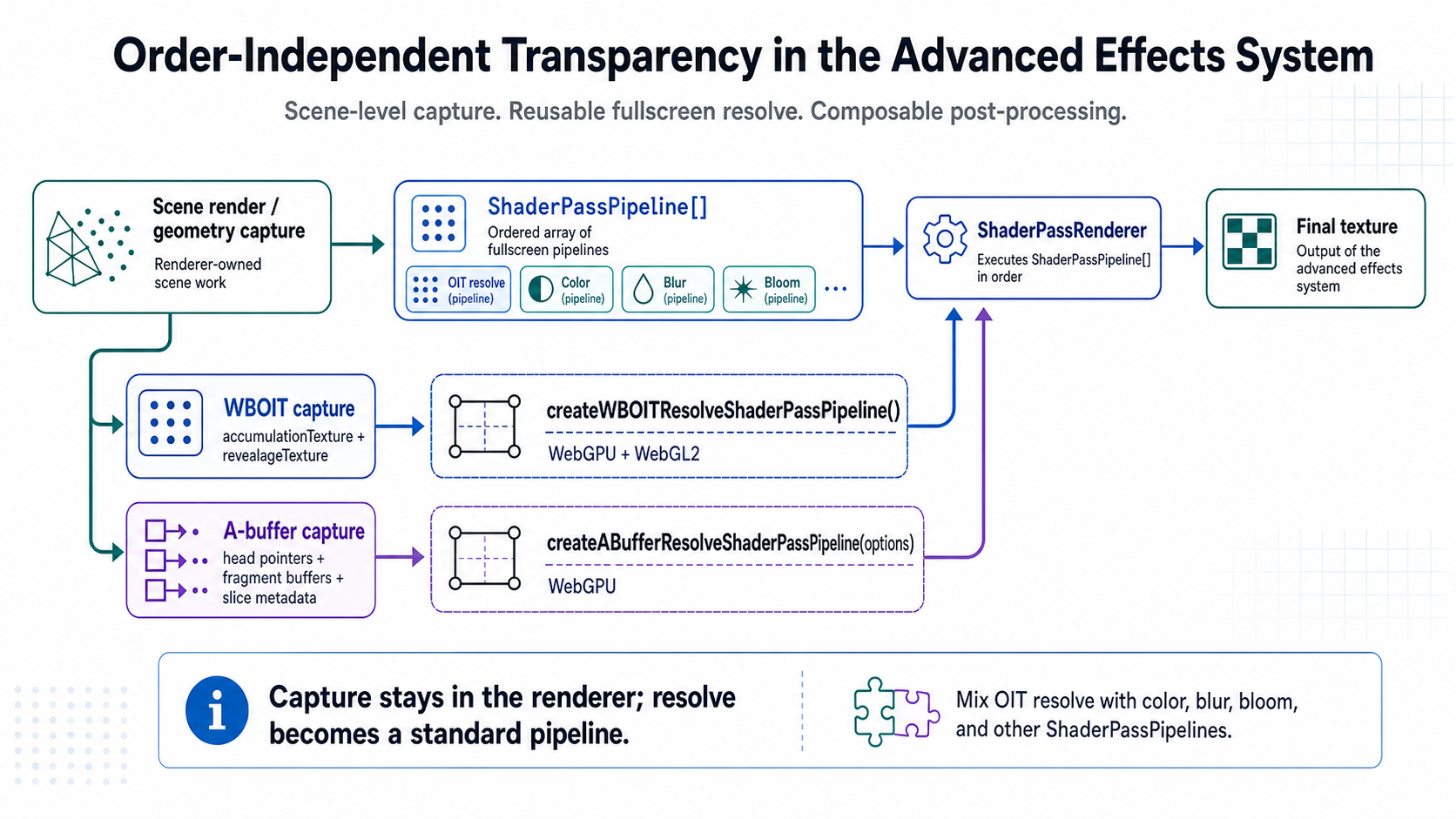
ABufferRenderercaptures, sorts, and composites per-pixel fragment lists on WebGPU. It offers the most accurate result but consumes bounded storage and performs per-pixel sorting.WBOITRendereraccumulates weighted color and revealage on WebGPU or WebGL2. It avoids sorting and storage buffers, but the result is approximate and requires two translucent geometry passes.
Both renderers leave scene models, shader inputs, command submission, and fallback selection under application control.
Compare A-buffer, weighted-blended, and ordinary alpha blending on the same overlapping scene:
Optical Materials
glassMaterial provides portable WGSL and GLSL
screen-space refraction, Schlick Fresnel reflection, chromatic dispersion, and Beer-Lambert
absorption. reflectiveMaterial adds
lightweight glossy highlights and Fresnel-weighted environment reflection for other surfaces.
Both modules share opticalLighting, expose a ShaderPlugin, and can be composed with sorted
alpha, weighted-blended OIT, or A-buffer OIT. emissiveMaterial shades self-illuminated objects,
and opticalPointLights supplies a bounded, portable array of moving colored lights for the
illuminated glass and reflective helpers. HDR transparency output can then feed reusable bloom
and tone-mapping shader passes.
The Transparency and Glass Effects guides describe render ordering, backend constraints, local lighting, and physically based limitations.
SpectralCausticsRenderer provides
a WebGPU-only geometry-derived alternative to the analytic opticalCaustics helper. It captures
one convex refractor from a light view, traces six wavelength bands on the GPU, accumulates an HDR
XYZ map, and exposes the spectralCaustics receiver module for additive planar lighting.
Hybrid Shadows
ShadowMapRenderer provides WebGPU-only
cascaded directional, spot-array, and point cube-array maps with PCSS filtering. Applications draw
casters through a per-view callback and explicitly multiply the shadow module's factors into
their direct-light terms. A companion shader-pass pipeline adds primary-sun contact refinement.
Packed Pixel Formats
RGBADecoder and TEXTURE_FORMAT_PIXEL_DECODERS provide the existing experimental helpers for
encoding and decoding packed texture formats.